
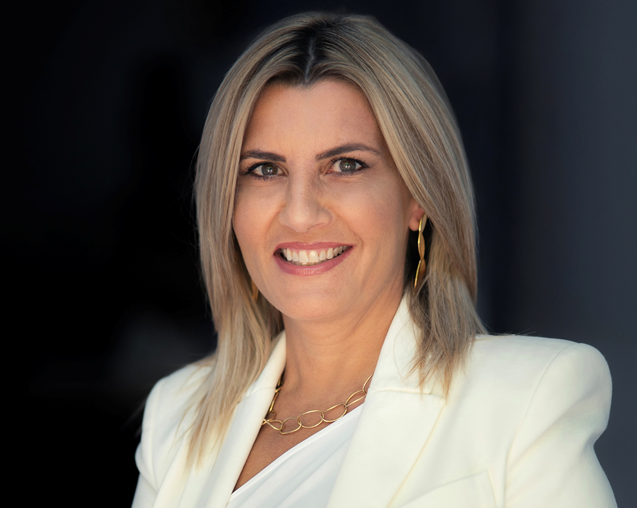
Dr Katerina Gavala
Watching yesterday’s events across Greece, and especially those held in Heraklion, I reflected on how certain dates have already been judged by History.
And then there are dates that return every year, confronting us once again with the same fundamental questions.
For me, 3 September is one such date.
As a woman who grew up and continues to live in the Dodecanese, I see it as more than a milestone in the history of a political party. I see it as the expression of a comprehensive political vision—one that gave the regions greater importance and recognised that distance from the centre must be accompanied by equal access to rights, services and opportunities.
On our islands, we know only too well the cost of distance. It costs time and money. It means more difficult access to doctors, education and public services. We also know how decisive that cost can become when a young person or a family must choose whether to remain, build a future and create something in their homeland.
The National Health System was one of the most meaningful expressions of that political vision. For island Greece, it meant establishing healthcare as a universal right, with services extending to the regions—even where geography makes every aspect of planning more demanding. It is something we now rightly regard as self-evident.
The same applies to ports and airports. In the Dodecanese, they represent far more than development infrastructure. They are our connection to the rest of the country and our means of accessing employment, education and medical care. For the smaller islands, reliable transport links are a fundamental prerequisite for life and economic activity throughout the year.
This is precisely where social policy, regional development and national cohesion converge.
The same was true of education. For many families in regional Greece, the opportunity for a child to study and gain access to different professional prospects represented genuine social mobility. The next generation was able to move forward.
There was also another transformation that concerns me personally as a woman: the reform of family law, the abolition of the dowry system, the advancement of equality and the increased participation of women in employment and public life. For my generation, these changes created the ground on which we could stand and demand more—with a new sense of confidence and freedom.
This is a political legacy I acknowledge without hesitation.
Every legacy, however, faces a choice: it can become the foundation for something new, or remain a beautiful page in History.
That, in my view, is where today’s challenge lies.
The Greece of 2026 needs modern answers to the inequalities that geography continues to create.
In the Dodecanese, this is directly connected to planning that takes account of seasonality and the actual population served by our public services. Kos in August, for example, has vastly different needs from Kos in January.
It is connected to reliable and affordable air and ferry services throughout the year. It requires meaningful incentives enabling doctors, nurses, teachers and young professionals to live, work and build their lives on the islands.
It is about ensuring that Kastellorizo—and every island on Greece’s borders—has a place in everyday public policymaking, carrying exactly the same importance that it holds on our national map.
All these issues transcend party boundaries.
Distance, the need for medical care, travel costs and the anxiety surrounding an emergency medical transfer come before political allegiance. They affect every island resident, regardless of how they vote.
This is precisely what I believe is worth preserving from 3 September: a political approach that understands social policy for the islands as both development policy and national policy.
It is a vision that begins with people, accurately understands geography and transforms insularity into equality, opportunity and national strength.