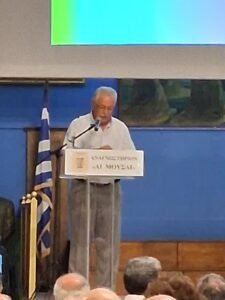


Emmanouil G. Mousellis, Coordinator of the Kalymnos Regional Unit, has announced an initiative to bring together all relevant professional and institutional bodies in an effort to identify solutions for the reopening of the local Architecture Council of the Kalymnos Regional Unit.
His intervention follows the abolition of the Council’s independent status and the transfer of its responsibilities to the corresponding Architecture Council in Kos, after the authorities were reportedly unable to find enough members to establish the local body.
Mr Mousellis described the development as the result of “an institutional failure by the state, the government and the Technical Chamber of Greece,” stressing that placing Kalymnos under the jurisdiction of the Kos council was not the solution sought for the islands.
Administrative support had been offered
According to the statement, Mr Mousellis was verbally informed by the Kalymnos Standing Committee of the Technical Chamber of Greece in mid-August about a proposal, dated July 29, 2026, by the Secretary General of the Ministry of Environment and Energy to abolish the local council.
“The Kalymnos Provincial Administration will not watch this problem from a distance or limit itself to examining who formally holds responsibility. When an issue directly affects the community and the local economy, local government must seek solutions and cooperate,” Mr Mousellis stated at the time.
Despite the severe staffing limitations faced by the Kalymnos Regional Unit, which reportedly operates with only 15 employees, the local administration offered to provide an administrative officer to support the Council’s secretarial operations, provided that such an arrangement was legally and institutionally possible.
The proposal was also submitted in writing to the Secretary of the Decentralized Administration of the Aegean through letter No. 4439/24.8.2026, with copies sent to the President of the Dodecanese branch of the Technical Chamber and the President of its Kalymnos Standing Committee.
Interventions failed to produce the desired outcome
Mr Mousellis said that efforts to approach government officials were intensified with the participation of members of the Kalymnos Standing Committee. These interventions, however, did not achieve the desired outcome.
The Regional Unit had also proposed mobilising all affected professional groups across the islands, including engineers, architects, construction workers and transport operators.
According to the Coordinator, the geographical conditions, distances, residents’ needs and development potential of the islands require strong and fully operational public services based locally, instead of the continued transfer of responsibilities and administrative structures elsewhere.
“This unfortunate development is a reason for more work and stronger demands,” he stressed, announcing the immediate convening of all relevant bodies to explore possible solutions for restoring the local Architecture Council.
“Our islands need properly staffed and operational services close to their citizens. We will continue fighting for this,” Mr Mousellis concluded.