
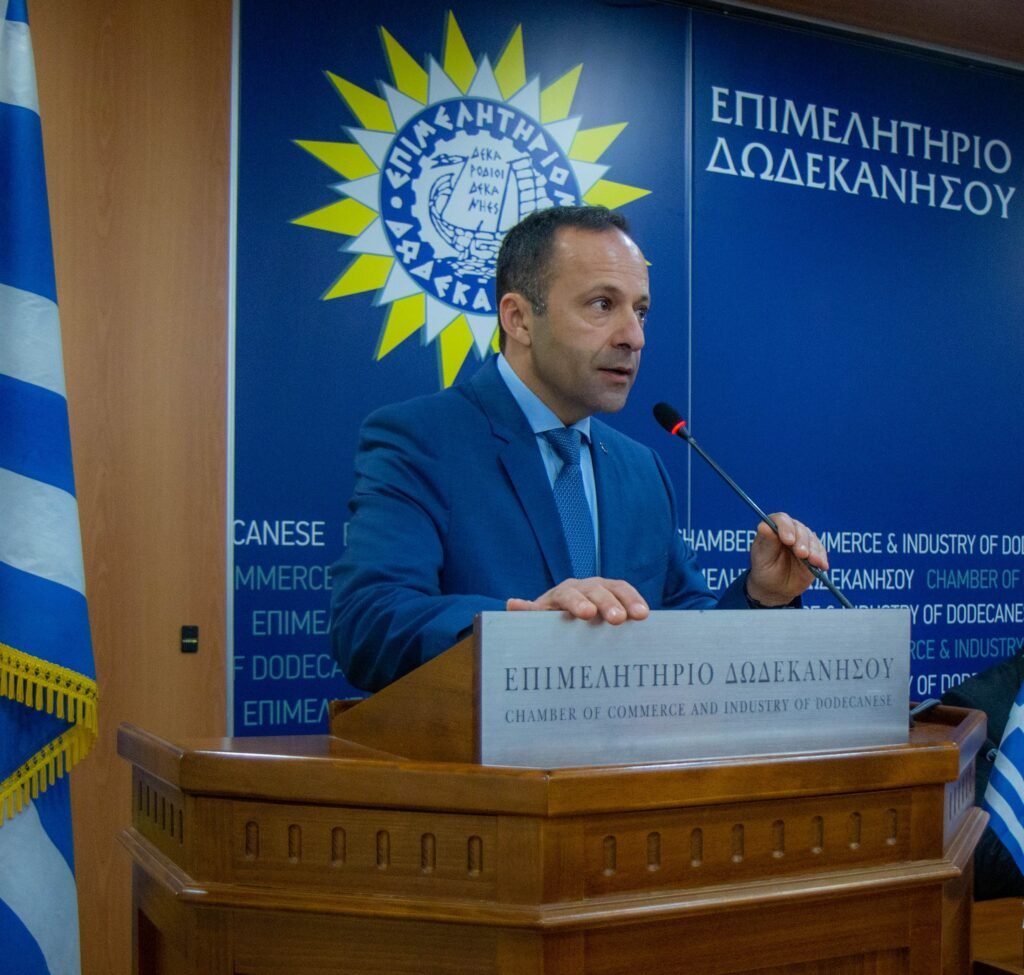
The measures announced by the Greek Prime Minister at the Thessaloniki International Fair include several positive interventions, but fail to provide targeted solutions for the country’s islands, according to Yannis G. Pappou, President of the Dodecanese Chamber of Commerce and Industry.
Mr Pappou welcomed the support announced for pensioners, public-sector employees, families with three or more children and people with disabilities. He also described the measures for self-employed professionals and the permanent nature of several interventions as positive developments that could strengthen disposable income, consumption and the wider market.
He also welcomed the abolition of the business tax for companies, initially in regional areas. However, he noted that the corporate advance tax payment remains at 80%, tying up valuable liquidity, while its gradual reduction is not expected to begin until the 2028 tax year.
According to the Chamber President, more immediate measures are needed to improve business liquidity and reduce operating costs. He also identified the high cost of food, energy, fuel and transport as the most pressing problem facing households and businesses, calling for more effective and systematic market inspections.
Mr Pappou placed particular emphasis on the additional financial burden faced by island communities. The cost of transporting goods, fuel and passenger travel, along with expensive air and ferry connections, continues to place residents and businesses at a disadvantage. He also pointed to persistent delays and operational problems affecting Greece’s Transport Equivalent subsidy scheme.
“No specific measure for the islands emerged from the announcements at the Thessaloniki International Fair,” Mr Pappou stressed. The Dodecanese, he explained, will benefit only from the general measures applying nationwide, without any separate provision addressing the additional costs created by insularity.
He argued that the islands continue to be treated as though they operate under the same economic conditions as mainland Greece—an approach that effectively treats unequal regions as equals.
Against this background, the Dodecanese Chamber of Commerce and Industry is renewing its demand for the extension of reduced VAT rates to Rhodes, describing the measure as an essential tool for offsetting the higher cost of island life and improving the competitiveness of the local economy.
Mr Pappou noted that expectations ahead of the Thessaloniki International Fair had been higher, particularly regarding support for entrepreneurship and the introduction of a distinct island policy. The Chamber, he said, will continue campaigning for stronger business liquidity, lower transport costs, the effective operation of the Transport Equivalent scheme and the restoration of reduced VAT rates.
“Insularity must now be recognised in practice through policies and tools that reflect the real operating costs of island economies,” the President of the Dodecanese Chamber concluded.