
By Georgios I. Chrysoulis, Secretary of the Holy Metropolis.
“Holy Week” or “Week of the Passion” is, according to the Christian liturgical calendar, the last week of Great Lent.
It begins on Palm Sunday and ends on Holy Saturday, and is dedicated to the Holy Passion of Jesus Christ.
The week before Easter was called “Great” from the very first Christian centuries because, as Saint John Chrysostom explains, great and world-saving events took place during it. At the center of these events are the holy and immaculate Passion, the divine burial, and the glorious Resurrection of our Lord Jesus Christ.
PALM SUNDAY
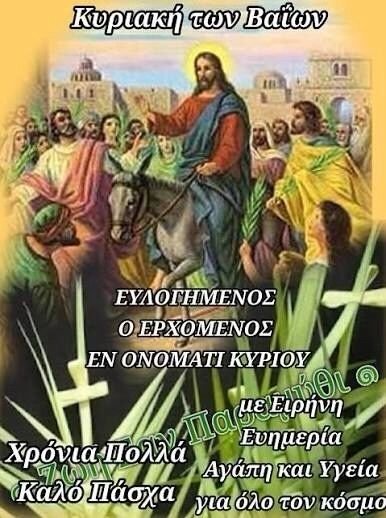
“The Entry of Our Lord Jesus Christ into Jerusalem”
This Sunday is called Palm Sunday because Christ was welcomed into Jerusalem “with palms and branches.” He entered the city not with royal luxury, but seated “on a colt,” while people and children, in joy and jubilation, came out to greet Him with loud acclamations, holding palm branches:
“Hosanna to the Son of David! Blessed is He who comes in the name of the Lord, the King of Israel!”
Thus the prophecy of David was fulfilled: “Out of the mouths of infants and nursing babes You have perfected praise.”
On Palm Sunday, Divine Liturgy is celebrated in all parishes. A characteristic custom is the decoration of churches with palm branches. After the service, the priest blesses and distributes palm crosses and olive branches to the faithful, who keep them in their homes or elsewhere for blessing.
It is also customary to eat fish on this day.
From Sunday afternoon, the churches take on a mourning appearance, dominated by the deep crimson color (symbolizing the Blood of Christ), expressing sorrow and reverence for the One who is coming.
THE SERVICE OF THE BRIDEGROOM
“Behold, the Bridegroom comes in the middle of the night…”
On Sunday evening, the Service of the Bridegroom is held. It is deeply solemn, especially when the lights are dimmed and only candles remain lit.
“The sacred passions shine today like saving lights upon the world.”
HOLY MONDAY
Holy Monday invites us to remember Joseph.
Two main events are highlighted:
a) The life of Joseph, the 11th son of Patriarch Jacob. His story foreshadows Christ. Sold into slavery for thirty pieces of silver, he later rose to become a ruler in Egypt, saving his people.
b) The withered fig tree (Matthew 21:18–22), symbolizing spiritual barrenness and lack of good works.
The Church presents Joseph as a model of virtue and inner freedom, paralleling him with Christ.
HOLY TUESDAY – THE TEN VIRGINS
On this day, we recall two parables:
a) The Ten Virgins (Matthew 25:1–13), teaching vigilance and readiness.
b) The Talents (Matthew 25:14–30), teaching us to cultivate and multiply the gifts God has given us.
The parable of the Ten Virgins emphasizes readiness for Christ’s coming. The wise virgins were prepared; the foolish were not and were shut out.
The parable of the Talents teaches responsibility: each person must use their gifts for the benefit of others and for the glory of God.
In the evening, during the Bridegroom Service, the famous Hymn of Kassiani is chanted:
“Lord, the woman who had fallen into many sins…”
HOLY WEDNESDAY – THE ANOINTING
On Holy Wednesday, the Church commemorates the sinful woman who anointed Christ with myrrh. Her act expresses deep repentance and love.
That day, the Sacrament of Holy Unction is performed in all churches.
HOLY THURSDAY – THE LAST SUPPER
On Holy Thursday, we commemorate:
- The Washing of the Feet
- The Last Supper
- Christ’s Prayer in Gethsemane
- The Betrayal by Judas
Christ humbly washes His disciples’ feet and institutes the Holy Eucharist:
“This is My Body… This is My Blood…”
Judas betrays Christ for thirty pieces of silver.
This day also includes traditions such as baking Easter bread and dyeing eggs red, symbolizing Christ’s sacrifice.
In the evening, the Service of the Twelve Gospels is held, recounting the Passion.
HOLY FRIDAY – THE BURIAL OF CHRIST
Holy Friday is a day of strict fasting and mourning.
The faithful attend services commemorating Christ’s crucifixion and burial. The epitaphios (funeral bier) is decorated with flowers and carried in procession.
The hymn “Give me this stranger…” expresses deep sorrow.
It is customary to visit cemeteries and honor the departed.
HOLY SATURDAY – “COME RECEIVE THE LIGHT”
Holy Saturday announces the Resurrection.
The hymn “Arise, O God…” is chanted, and the joyful message begins to spread.
At midnight, the priest proclaims:
“Come receive the light!”
The faithful light their candles, and soon after, the proclamation is heard:
“Christ is Risen!”
Fireworks, joy, and celebration follow. Families return home with the Holy Light and share the Easter meal.
EASTER SUNDAY
Christ is Risen!
Easter is the Feast of Feasts and the Celebration of Celebrations.
The Myrrh-bearing women find the tomb empty, and an angel announces:
“The Lord has risen!”
The Gospel is read in many languages during the Service of Love.
The date of Easter was established by the First Ecumenical Council in Nicaea (325 AD): it is celebrated on the first Sunday after the full moon following the spring equinox and after the Jewish Passover.
Traditionally, lamb is roasted, symbolizing Christ, the sacrificial Lamb.
For forty days, Christians greet one another with:
“Christ is Risen!”
“Truly He is Risen!”