
AI image
By Sakellarios Tsikouris
Waste management and the effective elimination of uncontrolled waste disposal sites are not matters for publicity stunts designed to impress or appeal to popular sentiment. They are strictly technical, specialised and environmental issues, with a direct impact on public health and the safety of the island.
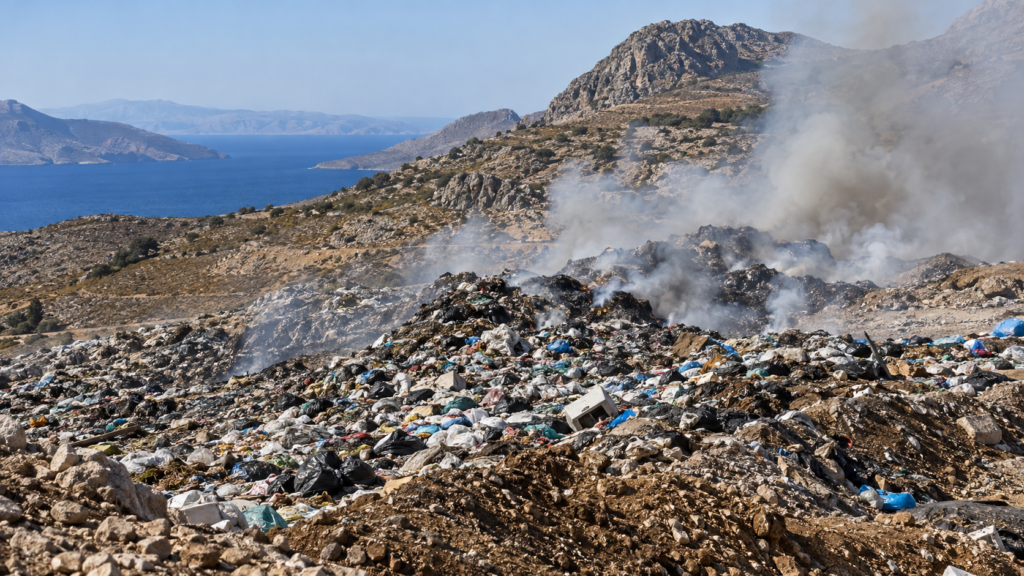
The latest fire at the Kalymnos uncontrolled landfill is a stark reminder of the harsh reality: endless tonnes of accumulated organic and plastic waste, the continuous production of flammable biogas—primarily methane—and high temperatures. This combination makes spontaneous combustion a mathematical certainty.
This is an active environmental “powder keg” that has still not received the technical and institutional attention it requires. The longer action is delayed, the longer the local community will continue to pay the price.
What “Landfill Remediation and Rehabilitation” Really Means
In public debate, the cessation of waste disposal, commonly described as “closure,” is often confused with full remediation.
Preventing refuse collection vehicles from dumping waste on a hillside does not mean that the landfill has disappeared. The accumulated waste remains in place, continuing to decompose and produce toxic leachate that can contaminate groundwater, as well as flammable biogas that fuels recurring fires.
The scientifically prescribed and legally regulated process of rehabilitating an uncontrolled landfill involves a number of highly demanding and costly stages, including the following:
Technical and Environmental Impact Studies: Comprehensive topographical, geotechnical and environmental studies are required to determine the volume and composition of the accumulated waste.
Earthworks: Dispersed waste must be collected and compacted, while the slopes must be reshaped and stabilised to prevent landslides.
Sealing Works: Special geosynthetic materials and impermeable membranes must be installed to seal the waste mass, preventing rainwater from penetrating it and generating additional leachate.
Biogas Management: Vertical biogas extraction wells must be constructed to allow controlled flaring, together with sealed tanks for collecting liquid leachate.
Flood-Protection Infrastructure: Perimeter drainage ditches must be built to divert stormwater away from the rehabilitated waste mass.
The “Immediate Tree-Planting” Publicity Stunt
Particular caution is required when superficial or poorly considered promises of “immediate tree planting” are made. In environmental engineering, landscaping and planting constitute the final stage of a comprehensive rehabilitation project.
Trees cannot simply be planted on top of uncontrolled tonnes of waste that are burning or releasing toxic gases.
Before planting can take place, the sealing layer must be completed, a specially designed layer of topsoil must be installed, and suitable native plants with shallow root systems must be selected so that their roots do not penetrate the impermeable membrane.
Any reference to “immediate planting” before these complex engineering works have been completed amounts to dangerous improvisation and little more than a publicity stunt.
Independent Implementation Without Expertise or Funding
Beyond public statements, there is a harsh reality that must be stated clearly: the Municipality of Kalymnos possesses neither the specialised expertise nor the financial resources required to carry out such a complex project independently.
Rehabilitating an uncontrolled landfill of this scale requires millions of euros, specialist environmental and geotechnical engineers, and heavy construction infrastructure.
The suggestion that the Municipality can simply “clean up” or “rehabilitate” the site using its own resources or through fragmented interventions by its Technical Department is an illusion.
The only realistic route is to complete all the necessary technical studies, secure funding through sectoral programmes—such as the EU-backed NSRF, the relevant Ministry or Greece’s Public Investment Programme—and work closely with the competent authorities, including the South Aegean Region and the regional Solid Waste Management Authority.
At the same time, all necessary measures must be taken to secure a permanent and sustainable solution for biowaste management—one that will not financially drain the Municipality.
The Time for Serious Action
A permanent solution to the uncontrolled landfill cannot be achieved through statements, blame-shifting or complacency. It requires:
- Acknowledging the reality and ending misinformation and unsupported claims.
- Tendering and implementing an approved technical remediation study through specialised bodies and contractors.
- Securing funding from national and European resources.
- Operating lawful waste-management infrastructure in parallel, including a composting unit, waste transfer station, recycling facilities and processing systems, to ensure that no additional waste is deposited at the site.
- Long-term monitoring for at least a decade after the rehabilitation works have been completed.
As long as those involved seek excuses in “arson scenarios” and promise unworkable solutions, the problem will remain. Along with it will remain the risks to public health, the environmental degradation of the island and the threat of further European fines.
The rehabilitation of an uncontrolled landfill is a major infrastructure project governed by scientific and technical requirements. It must be approached with seriousness, scientific expertise and responsibility—not treated as an arena for petty political confrontation.
Sakellarios G. Tsikouris
Chartered Electrical Engineer
President of the Kalymnos Standing Committee of the Technical Chamber of Greece
Member of the Executive Committee of the Technical Chamber of Greece – Dodecanese Department