

By Giannis Th. Patellis
Old, beloved habits always find a way to return to us. It happened today when I was forced to retrieve an old jacket from the back of the wardrobe after the one I was wearing got soaked. As I slipped my mobile phone into the left pocket — now the first ritual before leaving the house — my hand pulled out a komboloi. Useless now, a forgotten companion of our outings for some years, it too fell victim to the various smartphones and whatever else they are called, which have recently taken up permanent residence in our palms. The mobile phone has become the unquestioned accessory of our hands, the new “stress reliever,” if you will, for young and old alike. Very few still prefer the komboloi, once our cherished companion.
I had long intended to write about the komboloi, now that its reign is fading. Perhaps the time has come to repay that debt, prompted by today’s unexpected discovery.
Who created the komboloi — where, when, and why? Incredible as it may seem, no one knows. There is something charming in having been enamored with something unknown, something that kept both us and our hands company for such a large part of our lives.
What is the komboloi? A means of sensory pleasure, a way to cheat time, a reflection of personality, an amulet, a carrier of positive energy, a family heirloom, a piece of jewelry, a means of communication with God? One could go on listing its qualities, as many as its beads. Yet even these have no fixed number, especially in prayer ropes, the komboskoinia.
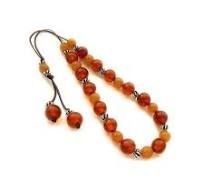
The Greek komboloi itself has no set number of beads. It counts nothing specific. Its size depends on the bead, the owner’s preference, and what feels right in the hand. Often, however, it is a work of art. The shape, size, material, the way the beads are linked, and the finish before the tassel — together they frequently compose an elegant craft. And of course, amber, rare and costly, remains the noblest material for a komboloi.
Once, we sought them out in accessory shops and specialty komboloi stores, where each person spent time according to temperament and character. Many songs were written and sung about the komboloi: “My little komboloi, you are my longing…”, “A bead on your pearl komboloi…”, “One woman, two men — a komboloi without beads…” Yet komboloi and women were not first entangled by folk songs, but by my friend Apostolis.
I met him many years ago when we were students in Thessaloniki. He came from Piraeus and studied law. He was a simply handsome fellow, but possessed that indefinable “something” that attracted women. Apostolis had three weaknesses: living in a room facing the sea so he could remember Kastella, komboloi, and women.
Each time he fell in love, the girl who learned of his passion would give him a komboloi. Whenever we saw a new one in his hands, it meant a new relationship. Over time, in both chronology and heart, the sequence was endless yet tangled: a student, a shop assistant, a schoolgirl, a young teacher, then a hairdresser… a whirl. Apostolis was diligent in his studies, but equally devoted to preserving his “romantic historical archive.” He placed the relics of his loves — the komboloi — in small boxes hidden in his wardrobe. Each box bore the name of the beloved: Litsa, Toula, Maria, Voula…
I met Apostolis again by chance many years later, at his law office on Akademias Street in Athens. His habits had not changed — only his tactics. Now each lover, for as long as the relationship lasted, was not only the komboloi in his hands but also his personal secretary. They were usually foreigners, since Apostolis handled labor disputes and his clients were mostly migrants.
When I visited his office, his secretary was a stunning Romanian woman named Nadia. Her eyes held an astonishing blue-green hue. In his hands, he held an equally beautiful komboloi with turquoise beads, a gift from Nadia. We agreed that if he ever decided to marry her — in his sixties by then — he would give it to me.
A few months later, I found a small parcel in my mailbox with no sender. Inside was an elegant wooden box containing the last komboloi I had seen in Apostolis’s hands. The same one I found today, forgotten in the pocket of my old jacket after so many years — its beads the color of Nadia’s eyes.