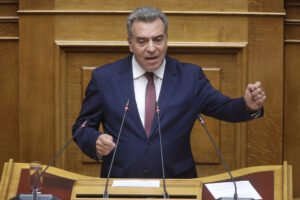


The abolition of the Eparch institution and its replacement by Regional Unit Coordinators prompted a strong reaction from Manolis Mousellis. Nevertheless, he remains the South Aegean Region’s senior administrative representative in Kalymnos—this time with a significantly expanded portfolio.
During a press conference held for local media on 4 September 2026, Mousellis described the abolition of the Eparch institution as an “institutional deviation” and openly expressed his dissatisfaction with a reform affecting primarily Greece’s island regions.
He noted that ten of the country’s 13 former Eparchies were located in the South Aegean, two in the North Aegean and one on Ithaca in the Ionian Islands. The reform therefore had its greatest impact on multi-island regions, where a permanent local representative of the Regional Authority is considered crucial.
Following the adoption of the relevant provisions of the new Local Government Code, South Aegean Regional Governor Giorgos Hatzimarkos announced the new administrative structure on 21 July 2026. The former Eparchs continued as Coordinators of their respective Regional Units and were assigned an extensive range of delegated powers. Manolis Mousellis was appointed Coordinator of the Kalymnos Regional Unit.
The Eparch’s powers in 2024
Under the 5 January 2024 decision appointing Mousellis as Eparch, his responsibilities covered six areas:
- Administration
- Agricultural economy and veterinary affairs
- Development and trade
- Public health and social welfare
- Culture, sport, lifelong learning and employment
- Transport and communications
Many of those powers, however, were advisory or limited to coordination and the issuance of specific administrative certificates.
In transport, for example, the Eparch could recommend the routes, starting points, stops and termini of intercity bus services and propose the minimum number of mandatory KTEL bus routes. He did not hold the broader decision-making and supervisory powers now delegated to the Coordinator.
His public-health responsibilities were mainly limited to coordinating health regulations and programmes, supervising inspections of food businesses and certifying vehicles used to transport food.
The Coordinator’s expanded responsibilities
The new framework substantially broadens the Coordinator’s administrative and executive role across six policy areas.
Public health and social assistance
The Coordinator is responsible for:
- Coordinating the implementation of health regulations and public-health programmes.
- Supervising health inspections of shops, workshops and food-processing businesses.
- Certifying vehicles used for food transportation.
- Issuing local health regulations and environmental-health measures.
- Licensing public and private laboratories conducting microbiological tests on water, food and beverages.
- Issuing export certificates to food and beverage businesses.
- Ordering inspections of schools, childcare facilities, shelters, soup kitchens, social grocery stores, camps and camping sites.
- Ordering checks concerning domestic animals and unhealthy conditions, including sewage leaks, stagnant water and accumulated waste.
- Supervising enforcement of smoking restrictions and the ban on alcohol sales to minors.
- Supervising mosquito-control programmes.
- Licensing semi-independent living facilities for people aged 15 and over.
- Issuing or revoking certain professional certificates.
- Issuing free-movement cards for people with disabilities.
Primary sector
His responsibilities include:
- Proposing annual and multiannual programmes for agriculture, livestock farming and fisheries.
- Proposing infrastructure programmes for agricultural processing.
- Proposing annual land-consolidation programmes.
- Coordinating animal-health programmes.
- Issuing certificates for olive and vineyard registers.
- Issuing opinions and certificates concerning agricultural storage facilities.
- Certifying beekeeping programmes.
- Issuing certificates concerning aquaculture and fisheries data.
- Approving recreational fishing activities.
- Approving the use of diving equipment for research.
- Providing consent for the import of live aquatic organisms for farming or water enrichment.
- Establishing committees required by law.
- Issuing non-health certificates concerning livestock within the Regional Unit.
Transport
Transport is one of the areas in which the Coordinator’s powers have increased most substantially. They now include:
- Determining urban and intercity transport networks.
- Implementing legislation on passenger stops and shelters.
- Arranging the transport of refugees and migrants to and from accommodation facilities.
- Approving the hire of public-use private vehicles for transporting people or materials.
- Revoking intercity bus circulation licences.
- Issuing, renewing and revoking professional licences for passenger and freight road carriers.
- Authorising workshops to install speed-limitation systems.
- Determining the minimum number and daily distribution of mandatory KTEL bus services.
- Determining fares within each KTEL operator’s area.
- Determining intercity routes, starting points, stops and termini.
- Supervising professional training schools for transport operators.
- Supervising schools for drivers transporting dangerous goods.
- Supervising car parks, vehicle and motorcycle parking facilities.
- Supervising car-wash and lubrication businesses.
- Supervising roadside-assistance companies.
- Supervising driving schools and theory-training centres.
- Supervising professional training centres for passenger and freight drivers.
Development and trade
The Coordinator is also responsible for:
- Appointing members of committees examining bread samples.
- Establishing inspection teams and administrative committees.
- Licensing heating-oil sellers.
- Issuing licences for the distribution of bottled liquefied petroleum gas.
- Issuing LPG bottling and related licences.
Culture, sport, lifelong learning and employment
The expanded portfolio includes:
- Proposing regional sports programmes and joint events with local organisations.
- Supervising sports clubs.
- Supervising cultural and other non-profit associations.
- Validating the official ammunition and firearms records of shooting clubs.
- Licensing official Group Z2 sporting events.
- Licensing outdoor sporting and road events.
- Licensing amateur dance schools and higher schools of drama, dance and cinema.
- Proposing employment quotas for third-country nationals.
- Approving the use or alteration of business names by private tutoring schools.
- Establishing councils and committees falling under the Ministry of Labour and Social Security.
Administration
In the administrative field, the Coordinator is empowered to:
- Establish committees for the disposal of materials and archive clearance.
- Issue certificates concerning the operation of Regional Unit services.
- Sign documents and requests addressed to public utilities, municipalities, postal services and other bodies.
- Issue opinions and recommendations concerning the operation of services.
- Appoint employees authorised to certify copies and signatures.
- Appoint Regional Unit employees to inspection committees.
- Co-sign annual-leave forms for employees.
- Issue travel orders and movement forms for official vehicles.
- Certify employees’ overtime work.
- Appoint a member of staff to assist with the preparation and processing of the Coordinator’s responsibilities.
The title was abolished—but the powers increased
A comparison of the two decisions reveals a striking contradiction: although the institutionally stronger title of Eparch was abolished, the newly appointed Coordinator received a broader and more substantive range of delegated powers.
The greatest expansion concerns transport, public health, the supervision of professional activities and the internal administration of Regional Unit services. In several areas, the role has shifted from merely making recommendations to taking decisions and exercising direct supervision.
This expansion followed an intervention by Regional Governor Giorgos Hatzimarkos, who sought to maintain a strong regional presence across the islands and offset the institutional gap created by the abolition of the Eparchies.
For Manolis Mousellis, however, the institutional objection remains. While everyday operations may continue largely unchanged—and his delegated responsibilities have actually increased—the abolition of a long-established institution of island local government remains, in his view, a negative development.