
By Eleftheria Tiliakou – No Filter
Alternative Voting in the Municipality of Kalymnos: Democratic Innovation or New Electoral Mechanisms?
The changes promoted under the new Local Government Code for the 2028 municipal elections introduce one of the most significant reforms in local administration in recent decades: the “Alternative Vote.” For the first time, voters will not only choose their primary municipal ticket, but will also have the option to indicate a second-choice combination on the same ballot paper. The government presents the new system as a model designed to encourage broader consensus, avoid repeat elections, and strengthen political cooperation. However, in small communities such as Kalymnos, an intense debate has already begun: Could the new system ultimately strengthen organized electoral mechanisms instead?
The Complexity of the New Ballot
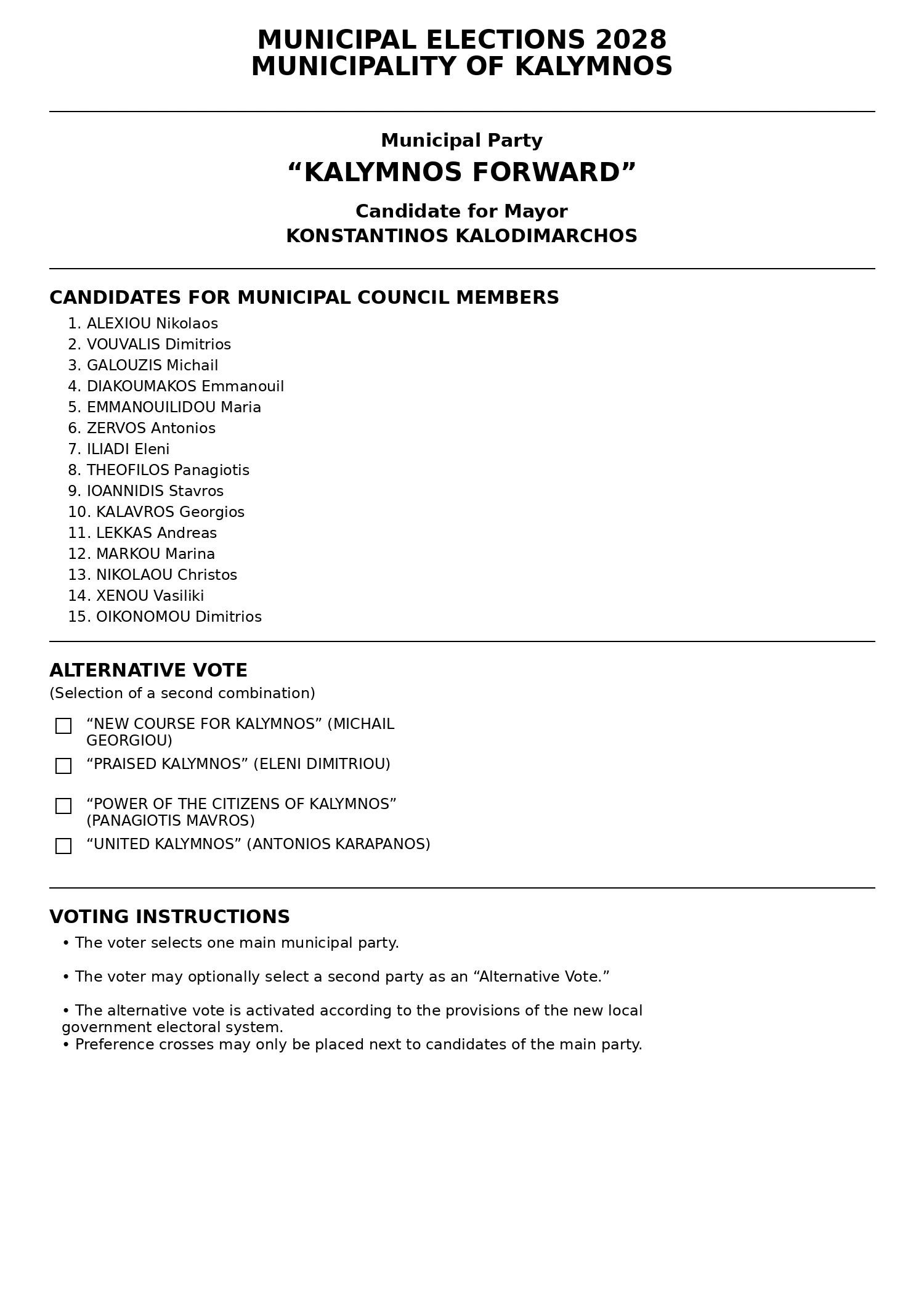
The new ballot will include the main electoral combination, municipal council candidates, preference crosses, and a special “Alternative Vote” section where voters may choose a second combination. This means that the voting process becomes significantly more complicated than the system citizens have known until today. And this raises the first major question: The more complex the ballot becomes, does the likelihood of “ready-made ballots” also increase? In close-knit societies such as Kalymnos, many believe the answer is “yes.”
The “Ready-Made Ballot” Gains Greater Importance
Municipal elections on small islands do not function in the same way as elections in large cities. Personal relationships, family ties, professional dependencies, and local influence networks play a decisive role. Until now, the “ready-made ballot” usually involved pre-marked candidate names, or suggested voting lists prepared by local political circles.
With the introduction of alternative voting, however, attention shifts to the voter’s second-choice combination as well. And this changes the political game entirely. An organized campaign mechanism may now be interested not only in who a citizen votes for first,
but also where that citizen’s second preference will ultimately go.
New Pre-Election Alliances
The new system creates a strong incentive for political agreements before elections take place. We may see mutual endorsements, “vote-transfer” arrangements, coordinated strategies, and even informal alliances between supposedly rival municipal groups. The message to voters could become: “Vote for us first — and choose X as your alternative vote.” In practice, this means that the fully “pre-arranged” ballot may become more valuable than ever before.
The Scenario of “Satellite Municipal Tickets”
Political observers also point to another possibility that could emerge in local elections:
The creation of “satellite” or controlled municipal tickets. In other words, a strong municipal faction that cannot politically cooperate with another existing group, does not want to direct second-choice votes to a traditional rival, or wishes to maintain complete control over its electoral influence, could theoretically support the creation of a “friendly” secondary ticket. This new combination might appear independent, target a different audience, yet in practice, function as a reservoir for alternative votes.
Voters could then receive direct guidance such as: “Choose us first — and our cooperating group second.” If such a scenario develops, the alternative vote may lead not only to cooperation but also to more sophisticated mechanisms of political influence. In small societies like Kalymnos, where personal relationships are strong, elections are often decided by only a few votes, and political balances remain fragile, Such a system could radically transform electoral strategy.
The Other Side of the Debate
Supporters of the reform argue that alternative voting promotes consensus, reduces extreme polarization, and encourages a more civilized political climate. They also argue that, if citizens gain more options, the phenomenon of the “wasted vote” is reduced, and costly second-round elections can be avoided. Whether the new system will create a culture of cooperation or a new form of controlled voting remains to be seen in practice. And perhaps the first true political “experiments” will take place in municipalities exactly like the Municipality of Kalymnians.
Sample ballot based on the proposed changes of the new local government electoral law for the 2028 elections.