
By Maria Chatzichristodoulou
“Today, the last piece of the Sagrada Família was placed after 144 years.” That was the headline that caught my eye a few days ago. A photograph of the iconic basilica accompanied it, the suspended arm of a crane hovering above the structure. As I looked at that image, something inside me clicked — as if a missing piece within me had found its place in an unfinished construction, or as if a long-pending pause had finally been resolved.
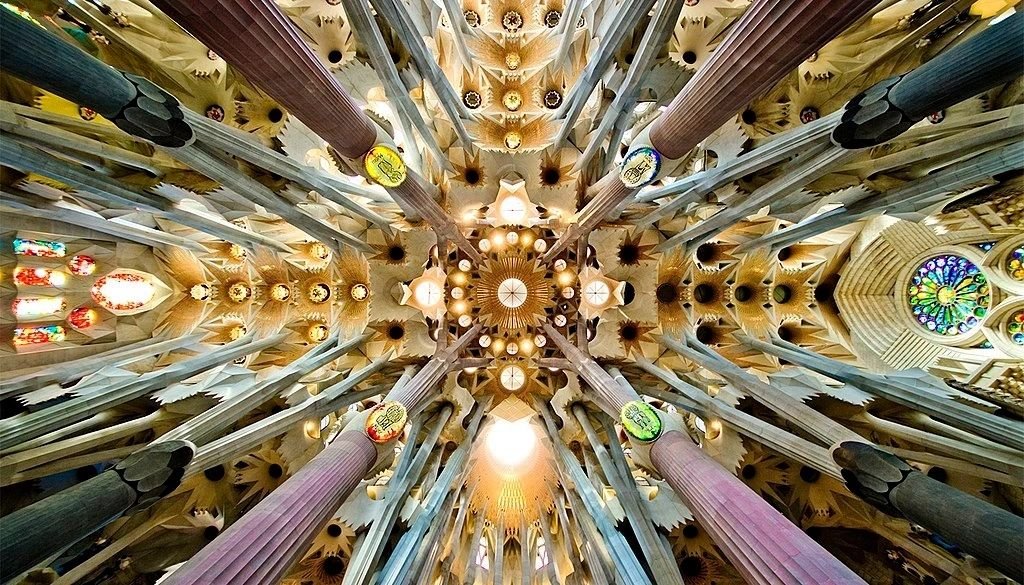
I have never visited Barcelona. I have never seen Gaudí’s wondrous architectural world up close — the visionary Catalan who devoted himself to the Sagrada Família, the work of his life, until the moment of his tragic death. I know nothing more about this extraordinary monument than the average art lover. My connection to it has been purely aesthetic: the pleasure of contemplating a masterpiece that blends Gothic and Islamic elements, fluid and curved lines harmonizing with nature, softening the rigid verticality of right angles as the temple rises toward the sky.
And yet, I could swear — in an existential sense — that I “heard” the deep, silent tone of a magical pause, a momentary redemption. It was as though the world stood still, time itself suspended, and nothing existed that could disturb the serenity spreading within me.
But everything quickly returned, rushing in to tear apart that defenseless calm and restore me to the dystopian order in which we live. I was left wondering how such a singular moment could affect me so profoundly. I considered the symbolism and the literal meaning of a work that tamed time, pierced the infinite sky with its vertical thrust, and proved that the Human Creator can still impose order upon chaos — can give form to precision, harmony, and justice; can validate spiritual longing; can approach perfection and transcendence.
Yet that explanation was not enough. I recalled the comforting — though perhaps overused — belief that “beauty will save us.” I remembered the countless times works of art had moved me deeply. But this was different.
What was it that I felt? What was this redemptive force that, in an instant, acted like the crane’s suspended arm and placed the missing fragment within me, allowing me — however briefly — to feel whole again?
Perhaps it was the sense that we are shrinking amid the barbarity of our times, collapsing around a fractured core, our pieces scattered everywhere: in flattened Gaza and the frozen tents of surviving Palestinians; in boats that become funeral beds for refugees; in the fields of war, hunger, destitution, corruption, and the terrifying resurgence of fascism in societies that roar with hostility.
Can Art become the Isis of our globalized syncretism — the force that gathers and reassembles our scattered fragments?
Uncertain of what truly lay behind my experience, I turned to Ernst Fischer’s now-classic work The Necessity of Art. His assertion that “art is necessary to us, by virtue of its inherent magic, for it always retains something of that magic” opened a small door of clarity.
I realized that magic today may be the feeling of reconnection — the momentary healing of our fragmented selves. It is the sudden cohesion granted by the aesthetic and intellectual emotion we experience when confronted with a masterpiece completed before our eyes.
Magic is the moment we harmonize with Nature — and with our own nature. These two forces unite in such a work of art. It becomes a “totem,” a symbol through which the human being emerges and returns to wholeness. In that moment, as Fischer suggests, humanity proves it remains the great magician — Prometheus bringing fire from the heavens, Orpheus taming nature with his music.
Or perhaps it is something simpler still: the emotion born from the knowledge that one person’s vision — an artist’s vision — has finally been fulfilled 144 years later. Perhaps it is nostalgia echoing prophetically in Brecht’s words: “From these cities will remain only the wind that passed through them.”
Maria Chatzichristodoulou is an educator and writer.