

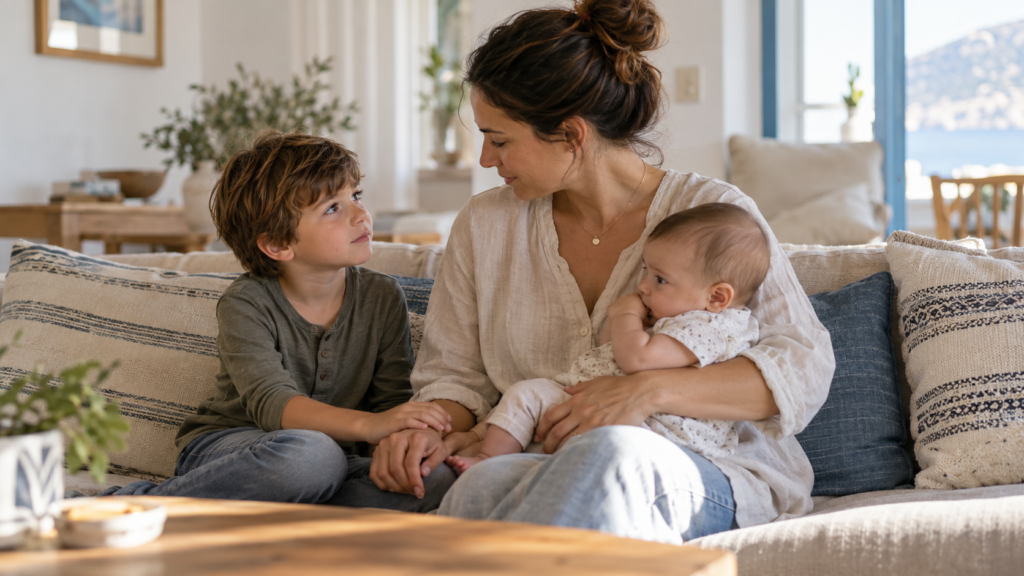
The question can come at the most unexpected moment. In the car, just before bedtime, or while Mum is holding the younger child.
“Mum, who do you love more? Me or my brother?”
Most parents will immediately reply that they love all their children equally. And, of course, that answer matters. But behind the question, there may be more than simple curiosity.
The child may be trying to understand whether they still hold the same place in their parents’ hearts. Whether the love they once felt belonged entirely to them now has to be shared. Whether Mum spending more time with the baby means they have become less important.
Jealousy between siblings is a very common experience within families. Even so, many parents struggle to manage it, particularly when it is expressed through anger, whining, aggression, or behaviour that seems to take a child back to earlier stages of development.
A child who had begun to become more independent may suddenly ask to be fed, want to be held all the time, or protest whenever their parents give attention to their sibling.
And at some point, they may hear:
“Are you really jealous of the baby? You’re a big kid now!”
But let us try, for a moment, to see the situation from their perspective.
Imagine that someone you love deeply, someone who has always shared a special relationship with you, announces that another person will now be part of their life and will need a large share of their time and attention. And because this new person is more vulnerable, their everyday needs will often come first.
You might understand the situation logically and still feel a little insecure.
For a young child who is still learning to recognise and manage their emotions, this change can be even harder.
Of course, this does not mean that every child feels jealous of their sibling in the same way or to the same degree. Some children adjust relatively easily, others express their distress openly, and others seem very cooperative on the outside while perhaps feeling pushed aside within.
Jealousy does not arise only when a second child is born, either. It may appear much later, when siblings begin comparing their achievements, the freedoms they are allowed, their friendships, or the attention each receives.
There is something here that deserves our attention.
Often, in our efforts to reassure children, we end up telling them how they should feel.
“There’s no reason to be jealous.”
“You know we love you both equally.”
“You have to love your brother.”
But emotions do not readily follow our instructions. A child can love their sibling and, at the same time, feel jealous of the attention they receive. They may want to play together and, a little later, become angry because the younger child has taken one of their toys.
These conflicting experiences are part of human emotional life. On their own, they do not mean that something is wrong.
Instead of trying to make jealousy disappear, we can help the child understand it.
“It seems you felt upset because I spent so much time with the baby. I can understand that you wanted us to have a little more time together.”
Acknowledging their feelings in this way can help the child feel understood. We do not need to accept every behaviour in order to recognise the emotion behind it.
If, for example, they hit their sibling, the boundary needs to be clear. We can stop the behaviour, protect the other child, and still acknowledge their anger.
“I understand that you’re very angry. But I won’t let you hit him.”
This distinction helps children learn that all emotions can have a place within a relationship, but not every way of expressing them is acceptable.
It is equally important to pay attention to the comparisons we make, often without even realising it.
“Look how quietly your sister is sitting.”
“Your brother could do that better when he was your age.”
“You’re the eldest. You need to set a good example.”
Such phrases can create the impression that children are competing for their parents’ acceptance. The older child, in particular, may feel that growing up has cost them the right to need care, understanding, or a little extra attention.
Fairness within a family does not necessarily mean giving every child exactly the same things. A baby has different needs from an eight-year-old, and a teenager needs a different approach from a primary school child.
What matters is that every child can feel that we see them as an individual, with their own needs, difficulties, and wishes.
Sometimes, small moments of one-to-one connection can also help enormously. A little time with one parent, a walk together, or a conversation without the other children present. These moments can remind the child that their special relationship with their parent still exists.
And one more thing: we do not need to pressure siblings to be loving and united all the time. As in any close human relationship, there will be disagreements, rivalry, anger, and moments when one does not want the other’s company.
Their relationship will develop over time, through both their shared experiences and their differences.
If jealousy becomes very intense, involves repeated aggression, or significantly affects a child’s everyday life, it is worth seeking further support to understand what is happening.
In most cases, however, jealousy offers us an opportunity to hear something the child does not yet know how to express in another way.
Behind “You love him more” may lie a need to feel important, seen, and secure within the family again.
And the answer to that need lies in more than the words we use to reassure them. Above all, it lies in the everyday experiences through which they will continue to discover that they have their own irreplaceable place in our lives.
By psychologist and family counsellor Giannis Xintaras