

Written by psychologist and psychotherapist Giannis Xintaras
All year long, we complain that we never have enough time.
We wake up in a hurry, rush to work, return home exhausted and face an endless list of responsibilities: children, bills, phone calls, messages and unfinished tasks. One day seems much like the next and, quite often, we find ourselves saying: “If only summer would finally arrive so I could get some rest.”
And then summer does arrive. Our obligations diminish, the alarm clock stops ringing, our phones remain silent a little longer, and the day stretches out before us without a schedule…
Yet this is precisely when many people begin to experience a strange sense of unease, as though they do not know what to do with so much free time. After only two or three days of holiday, some start feeling anxious or bored and constantly search for something to fill their schedule: excursions, activities, photographs, social media posts and new experiences—anything, as long as no room is left for “nothing.”
Could it be that “nothing” frightens us? Not because it is truly empty, but because, for the first time in many months, the noise of daily life fades and we begin to hear ourselves more clearly—and that is not always easy.
When our obligations come to a halt, thoughts we had no time to listen to throughout the year begin to surface. Questions we kept postponing. Feelings that were concealed beneath the constant rush. A tiredness that may not be merely physical, but emotional as well.
That is why the first few days of a holiday are often not particularly restful; they are more of a transitional period. The body needs time to leave behind its state of constant alertness. Just as a car travelling at high speed for hours cannot come to an immediate stop, neither can we move from continuous pressure to complete calm in a single day.
And perhaps we should not demand this of ourselves.
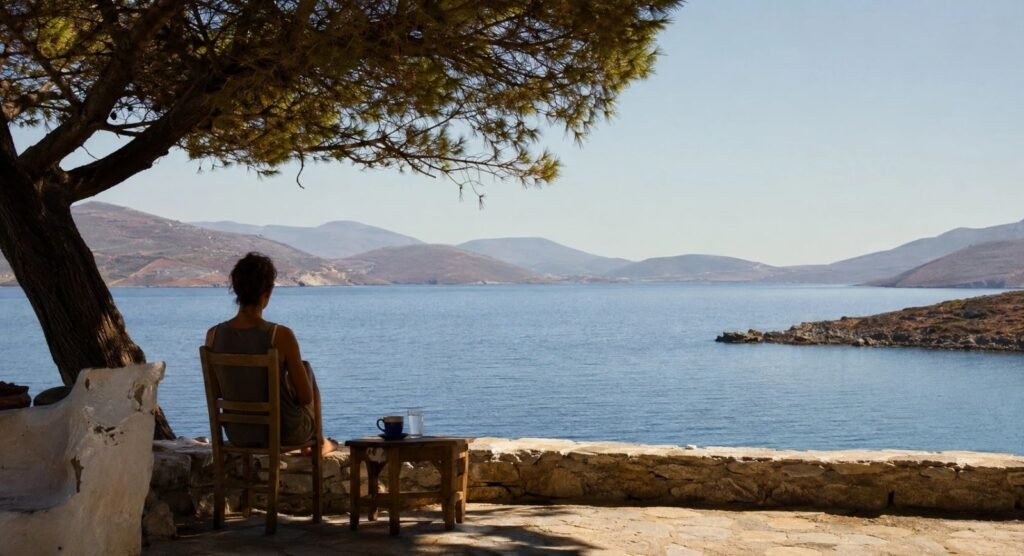
Summer is not a competition to see who can have the greatest number of experiences. Nor is it an obligation to remain constantly happy, sociable or creative. It can be something much simpler: sitting in the shade a little longer without looking at the time; reading a few pages of a book and leaving the rest for tomorrow; gazing at the sea without needing to do anything; walking without a destination; or talking to someone without being constantly interrupted by a mobile phone.
These moments may seem small, but they are, in fact, a way of reconnecting with ourselves.
Perhaps this is why so many people find it difficult to rest. They have learned to believe that they are worthy only when they are productive, useful, busy or solving problems. Being still makes them feel guilty, as though they are wasting their time.
But rest is not wasted time. It is the time during which the body regains its strength, the mind becomes quiet and the soul finds a little space to breathe.
So, if during the first few days of your holiday you feel slightly uncomfortable in the face of “nothing,” do not rush to fill it. Stay with it for a while.
Perhaps this “nothing” is not empty at all. Perhaps it is the space we never allowed to exist throughout the year. And perhaps, within this silence, we may finally hear something that the noise of everyday life has prevented us from hearing for so long: our own rhythm, our genuine needs and the reminder that life is not made up solely of everything we manage to do, but also of everything we truly take the time to experience.