
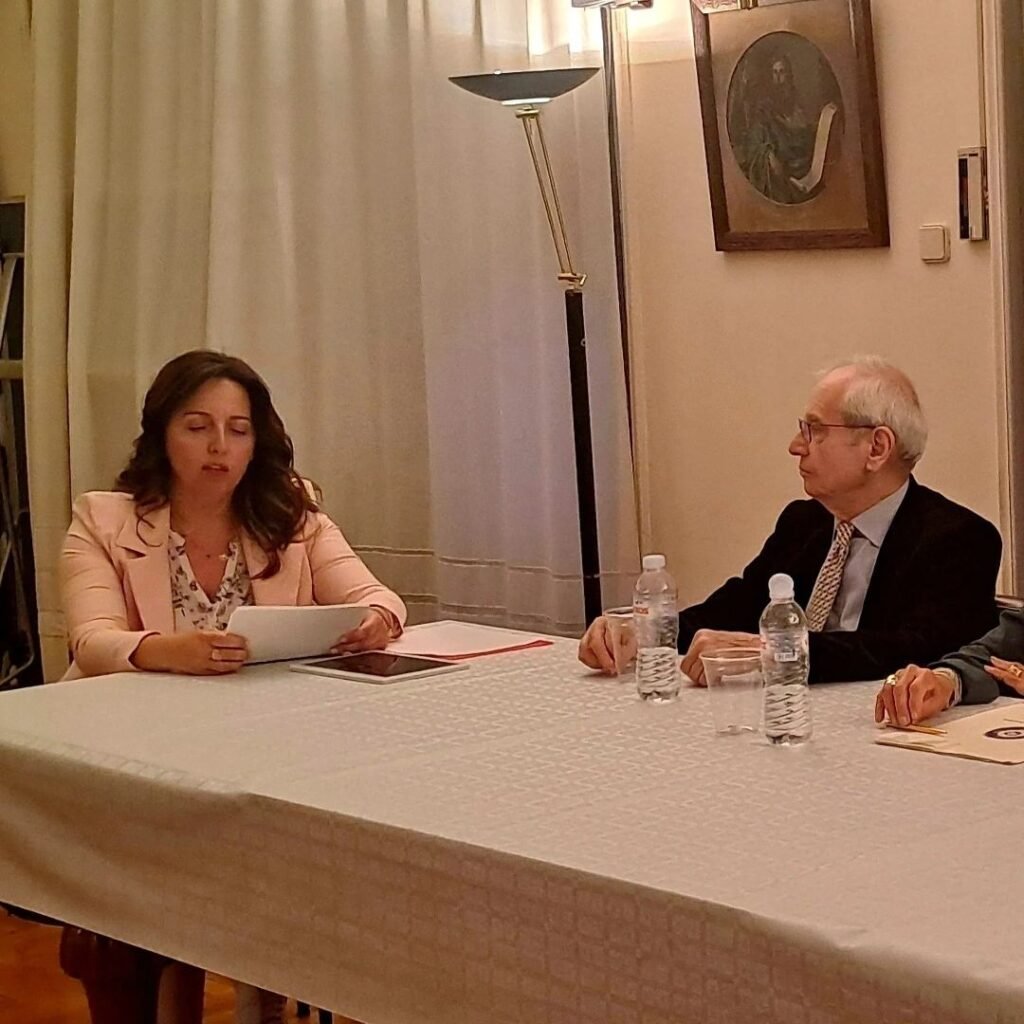
Sakellaris Trikoilis’ book, “12 Tsamadou Street, Exarchia, Athens,” was launched at the Union of Kalymnians of Attica, 46 Patission Street, on April 28, 2025, at 18:00. Below is part of the speech given by the book’s editor and the author’s daughter, Angeliki Trikoili.
“Thank you all very much for being here tonight. It is truly an honor for my family and me personally. And because, truthfully, I don’t have the right words to fully express how I feel at this moment—standing here in order to…
I will give a brief outline of how the presentation of the book “12 Tsamadou Street, Exarchia, Athens”, written by Sakellaris Trikoilis, will proceed. A book that waited many years to be published.
First, I will begin with an introduction, offering, as I believe necessary, some references to the history of the Tsamadou building, which no longer exists today, and the role it played for several decades in supporting underprivileged students from Kalymnos. I will also touch on the content of the book and the socio-political context in which it is set.
Then, our speakers will take the floor and present the book in more detail, and we will conclude with a reading of a few short, characteristic excerpts. I would like to express my heartfelt thanks to the guest speakers who agreed to present the book tonight.
It was a great joy and honor for me that they accepted my invitation without hesitation.
I won’t go into detailed biographies, as I believe no introductions are necessary… Each speaker has a different connection to both the book and its author. And I’m sure that this will shed a unique light on the book tonight.
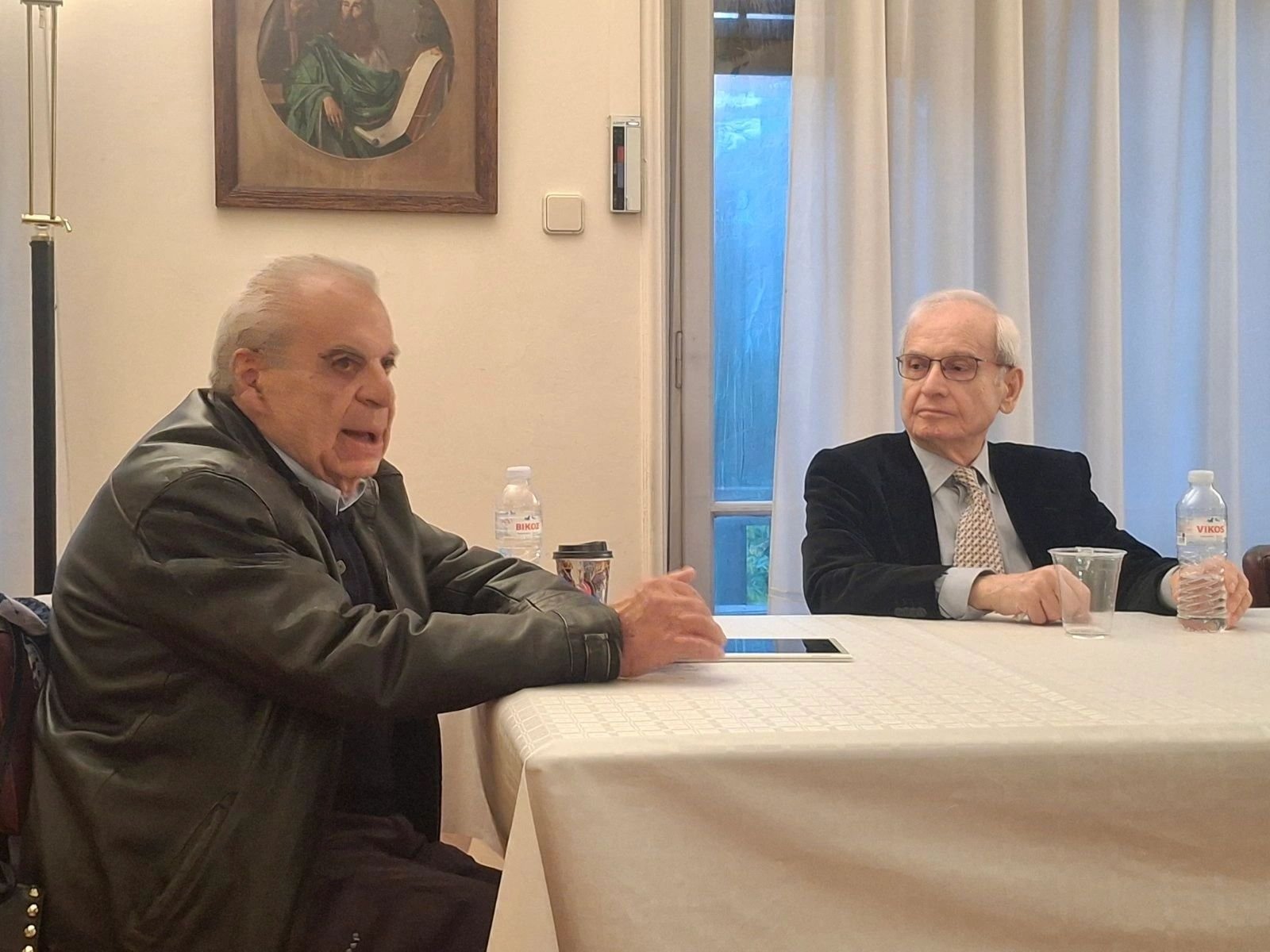
So, in the order they will speak, with us tonight are:
Mr. Nasos Vagenas, with his longstanding presence in literature and poetry. His literary criticism writings are a foundation for understanding the captivating art of language. He has also made a valuable contribution to higher education as a professor of Modern Greek Literature and the Theory and Criticism of Literature at the University of Athens. He also shared a close friendship with Sakis of Tsamadou. A relationship that runs through the book, with frequent references to him making it clear to me that he should absolutely be here tonight—prompting me, albeit hesitantly, to reach out to him.
I thank him again for his immediate and willing acceptance.
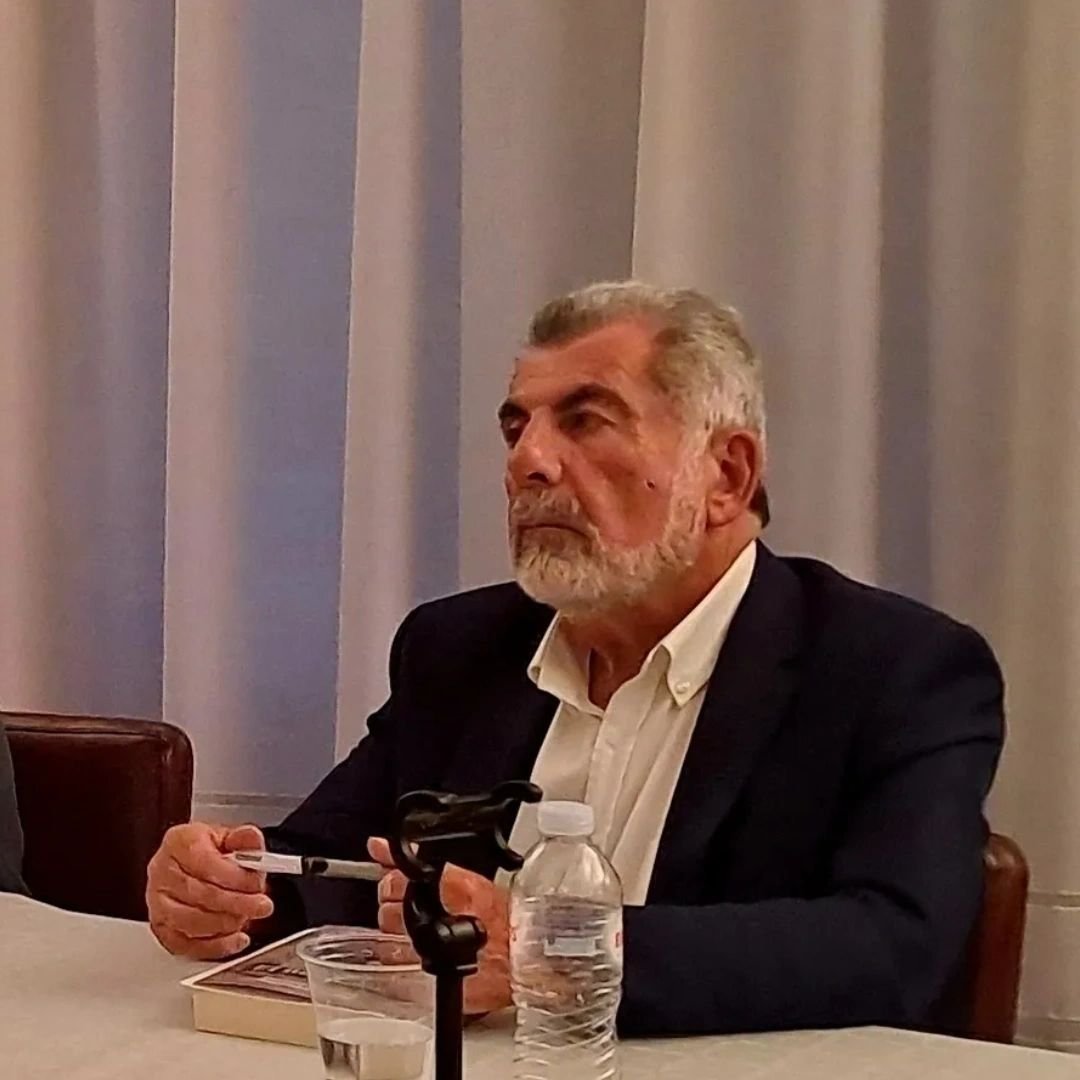
Mr. Giorgos Kassaras, known to all compatriots I believe, for his constant presence and contributions to our local society—as an MP for the Dodecanese, General Secretary for the Aegean & Island Policy, and a fellow citizen. A family friend with personal student memories from Tsamadou and a valued collaborator in recent years.
…
We will all be very interested to hear what they have to say.
Regarding the building at 12 Tsamadou Street: It was a donation and bequest to the Municipality of Kalymnos by the late compatriot Georgios Thomas, who, after many years of emigration to America and Australia, invested his savings in this neoclassical gem of Exarchia. The house had two floors, a semi-basement, and a large internal atrium with a courtyard.
From the mid-1950s to the mid-1970s, the “Kalymnian house” was a refuge for any young person who wanted to study but couldn’t afford to rent an apartment. No mayor ever visited the students, and the municipal council never made a specific decision about “Tsamadou,” as the building was called. Its self-management by the residents became synonymous with abandonment by Kalymnos’ local authorities. As a result, by the mid-1960s, the building had fallen into disrepair.
By the mid-1970s, the last student residents were forced to leave, and a year or two later, the City of Athens, in agreement with the Municipality of Kalymnos, demolished the “legendary” Tsamadou, as it had become dangerous.
- Among the residents there was always moving solidarity and mutual support, whether financial, health-related, or otherwise.
- Quiet hours were generally respected, especially during exam periods.
- Of course, there were exceptions—an impromptu musical band would occasionally stir the Exarchia neighborhood with pleasant noise.
- Another aspect of “Tsamadou” was the circulation and reading of newspapers from all political spectrums, and endless political and philosophical discussions.
- This, in fact, drew the attention of the Security Services, who kept the house under constant surveillance and dubbed it a “Hideout,” though I don’t believe any terrorists ever emerged from there…
- Intellectual games like chess tournaments and, admittedly, gambling also took place.
- In general, all forms of entertainment and learning were blended together.
As for the book: Personally, as I also mention in the introductory note, I did nothing more than piece together a very well-constructed puzzle and find the path to its publication.
Of all the books my father wrote—and those he left “on the way,” as he would say, on the hard drive he left behind—this one was always his favorite. He always talked about it and the stories of its characters. He worked on it for many years, with breaks, and although he passionately wanted to publish it, he put it off, believing he had a duty to prioritize the publication of other books—like The Modern History of Kalymnos, the bilingual Guide to Kalymnos, and the book on the Church of the Savior Christ and the Founding of Pothia—which he believed he owed to Kalymnos. (I’m not sure Kalymnos treated them with the respect they deserved.)
So the debt to himself could wait. That’s why it became a personal, non-negotiable duty for me to publish it and share the story of Sakis and his student gang at 12 Tsamadou.
I found a rich archive ready for composition, with sources from press clippings of the era (I’ll mention a few later) and photographs of the protagonists, which unfortunately couldn’t be included in the publication due to copyright and data protection restrictions.
So, the story goes something like this: In the peaceful neighborhood of Exarchia Square in the 1960s, in the self-managed student commune at 12 Tsamadou Street, islander students taught solidarity and learned the ABCs of life. Through the dense historical and political events of nearly a decade, from 1961 to 1973, Sakis’ youthful group encountered university education, philosophy, politics, and activism for the first time.
Struggles for survival, demands for free education, the student movement, protests, demonstrations, “114,” persecutions, the Apostasy, dictatorship. Student protests intensified and set the tone for social uprisings against the police state, while politics gradually collapsed, making way for the downfall of democracy.
Youthful awakenings, political awareness, ideals and disappointments—all interwoven with the societal transformation of a time brimming with events, hopes, failures, and upheavals.
Sakis’ journey: From the boarding house on Acharnon Street to the commune of Tsamadou 12. From a scholarship at the Athens Conservatory to admission to the Law School, and then enrollment at the Faculty of Philosophy, which won him over completely. Shifts between entirely different worlds, with different demographics, different expectations, and different demands. Transitions that defined much about Sakis, his personal development, and the shaping of his social and political consciousness. They helped him understand the world around him during a time of intense political and social change.
With extracurricular readings—which he took pride in—he tried to unlock life’s mysteries and philosophy’s secrets, always in search of the truth, as he said… He studied idealism and materialism—Marxism—and never surrendered to any of them. He always sought a deeper, real truth—not one manufactured in mental labyrinths or dark offices. He wanted the truth of life and reality, one that opens new paths. He spent countless nights at Tsamadou studying dialectics, trying to understand concepts that seemed like Chinese to most.
…
This book is written with youthful freshness and innocence, capturing the years of initiation into university life and the mysteries of Exarchia—the protests, the democratic demands, the student unionism. In an era of weak democracy and heavy police control, a harsh political landscape that didn’t forgive but surveilled and punished. Where today’s givens—like participating in movements, defending rights, and establishing the demotic language—were seen as hostile acts against the political system and led to the expulsion of the entire student association “Plato,” targeting activist students, excluding them from exams, and causing them to lose an academic year—some even left for abroad.
An important source I discovered in the book’s archival material was a statement from the student board of “Plato,” co-signed by some of the country’s most important intellectuals, supporting their cause and publicly opposing the harsh penalty of expulsion—though it made no difference in the end.
It’s worth mentioning: The 1966 statement by the Philosophical School’s “Plato” student association reads:
“Freedom of thought, freedom of speech, and open discussion are fundamental human rights. Referring 10 members of Plato’s board to the University Disciplinary Council because they organized a discussion last December on ‘Kalokairinos’ History Book and Educational Reform’ directly contradicts students’ basic rights as guaranteed by the Constitution.”
“Reviving laws and decrees from 1932 and 1935, which had not been enforced in 20 years, undermines the intellectual future of the country. As intellectuals, we remain committed to intellectual freedom and thus oppose the persecution of the 10 members of Plato’s board.”
Among the signatories:
- Yannis Ritsos (poet)
- Melpo Axioti (author)
- Dido Sotiriou (author)
- Iakovos Kambanellis (literary figure)
- Marios Ploritis (author)
- Kostas Varnalis (poet)
- Tatiana Gritsi-Milliex (author)
- Tasos Vournas (historian)
- Leonidas Kyrkos (politician)
- Lykourgos Kallergis (actor), among many others.
So, for Sakis, Tsamadou is the documentation and depiction of an entire era through personal journeys and the stories of friends, embedded in their historical and social context. It is the summation of his life, the essence of his worldview, and the distillation of his philosophy.
For us—as a family—it is a valuable legacy for the future, and for those who hold it in their hands, I hope it will be an engaging read.
Sakis of Tsamadou, who would have turned 82 today, April 28, may no longer be here. But it’s certain that he has never truly left us—and from wherever he is, he would be very happy about what’s happening tonight.
Thank you.“