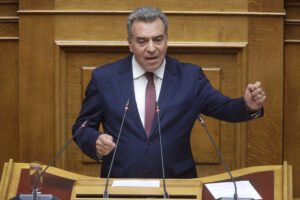


The following is the speech delivered by journalist Eleftheria Tiliakou at the 56th Conference of the Union of Regional Journalists at Kalampaka on October 30- 31 and November 1st 2026.
I would like to begin with an image we all recognise.
A town square full of people, silently looking at their phones. At the same time, an online discussion about a local problem attracts hundreds of comments. Two islands—one digital, one physical—exist in two parallel universes.
Where is public debate taking place? Who participates? Whose voice is heard? And how much does this discussion help society understand the problem and demand a solution?
These questions directly concern democracy and our own responsibility.
Physical public space is the shared setting of our social lives: the square, the street, the park, the church, the room where an open public meeting takes place. This is where we meet, exchange views, disagree, organise action and make our demands visible, face to face.
Digital public space encompasses online discussions, both in real time and through exchanges that unfold over time, through which news circulates, views are expressed and public opinion takes shape. A news post, readers’ comments and a public authority’s response form part of that space.
These two spaces are in constant communication. A neighbourhood problem becomes an online post. The post prompts a journalistic investigation. That investigation may lead to a residents’ meeting, an intervention at a municipal council meeting or a public commitment.
There is, however, a crucial difference: much of our digital public debate takes place on platforms owned by private companies. Their rules and algorithms influence what we see, what we scroll past and which voices reach a wider audience.
We have the opportunity to speak. The opportunity to be heard is distributed unequally.
Within this environment, the first major question arises: do we want citizens or content consumers?
Citizens have rights to equality, freedom, information and participation. They can question, scrutinise those in power, organise and demand accountability.
Exercising these rights requires space and time to think. It requires access to reliable information from sources citizens choose for themselves, rather than sources pushed into their social media feeds as content consumers.
The endless succession of posts, images and videos has accustomed us to a different rhythm: we look, react, comment and move on. A serious social issue competes for a few seconds of our attention before the next item appears.
This pattern limits how deeply we process information. It allows impressions to precede knowledge and momentary outrage to take the place of sustained demands for change.
Of course, a post can mark the beginning of an important mobilisation. Its democratic value also becomes apparent in what follows: whether it leads to specific demands, collective organisation and continued scrutiny of the responses.
For us, a corresponding question arises: are we safeguarding our role as journalists, or are we drifting towards the new role of content creators?
Producing content is part of our daily work. The journalistic mission, however, requires specific commitments: verification, independence, fairness in reporting and responsibility towards the public.
Journalists check a statement before repeating it. They seek out the document behind the announcement. They examine what a decision means for people’s lives. They demand answers and return to the story after the initial publicity has faded.
They also listen to those absent from online discussions: the older person who does not use social media, the worker who fears speaking publicly, the person who lacks the words or connections to make their problem visible.
Our journalistic judgement is tested precisely where an easy story promises a large audience. An unverified allegation may attract visits. It may also unfairly harm someone and undermine trust in the news.
In local journalism, this responsibility carries particular weight. We personally know many of the people we are called upon to scrutinise. We encounter one another every day. We share the same place and often the same concerns.
This closeness demands consistent standards and independence.
In Kalymnos, my own observation is that most confrontations between citizens and political figures now take place on social media—or, as I call them, antisocial media—while opportunities for organised, face-to-face dialogue remain limited.
This observation should give us pause.
When discussion revolves around insults, insinuations and personal attacks, the problem itself recedes into the background. Instead of examining a decision, we discuss who insulted whom. Instead of asking for evidence, we look for allies for the next confrontation.
And this atmosphere can spill over from the screen into everyday encounters. People arrive already angry, with fixed impressions of one another’s intentions. Insults become habitual, listening becomes harder and tolerance of opposing views fades.
Not every heated disagreement constitutes hate speech. Nor does every online conflict lead to physical violence. But normalising threats and portraying others as enemies creates conditions that can make escalation easier.
The freedom to criticise needs protection. So does the safety of those who participate in public debate.
At this point, I would like to give an example of how digital space has changed public debate in physical space. The Municipality of Kalymnos’s special accountability sessions—to avoid speaking in absolute terms—almost never take place, because the opposition submits no questions.
Does the opposition really have no questions? Does the municipal administration of the day not have a duty to account for its actions?
Let me offer one possible explanation for this phenomenon. The issues requiring accountability have already been discussed on social media, so there is no interest in raising them at the special sessions.
This could also be an opposition tactic, preventing those in power from giving an account of their actions in an official forum, because the informal forum of social media lends itself to monologues and comments posted at different times.
Monologues, ladies and gentlemen, are characteristic of other forms of government.
This phenomenon certainly warrants further investigation in other municipalities across the regions as well.
What, then, can we do?
We can strengthen open discussions in local communities, including hybrid meetings, allowing time for questions and meaningful answers. We can use live streaming to broaden participation. We can keep procedures accessible to those who are offline.
We can encourage the critical reading of news. We can correct our mistakes clearly and distinguish news from commentary and advertising—a distinction that the average reader and content consumer can no longer readily make, because we live in the age of post-truth.
Let me clarify what I mean by this term. Post-truth describes a situation in which verified facts have less influence on the formation of public opinion than emotions and personal beliefs.
Simply put, someone accepts a claim mainly because it fits what they already believe, fear or desire—even when strong evidence disproves it.
For example, an allegation about a municipality circulates. Documents establish that the specific claim is inaccurate. Yet someone continues to repeat it, saying: “I know what they’re like. That’s how they operate.” Their general belief carries more weight than the evidence relating to the specific case.
Emotion has a legitimate place in politics. Post-truth emerges when emotion becomes a reason to set verification aside.
For democracy, the danger is that we lose the shared factual basis on which we can disagree and hold those in power to account. We may make different judgements about public expenditure, but we need to be able to establish how much money was spent and for what purpose.
For this reason, as local journalists, we must bring into public debate what we learn primarily beyond the screen: in neighbourhoods, schools, hospitals and workplaces.
Ladies and gentlemen,
The future of our democracy is connected to the quality of the relationship between these two public spaces.
Digital communication can open avenues for participation. Physical public space can give that participation continuity, human contact and collective organisation. Journalism can connect the two through verified knowledge and meaningful scrutiny of those in power.
Our responsibility is to help people who read a news story better understand their world and be able to act within it.
To create the conditions in which disagreement leads to questions, questions lead to answers and answers lead to accountability.
Democracy grows stronger when every person has a voice, reliable information and a real opportunity to influence our shared life.