

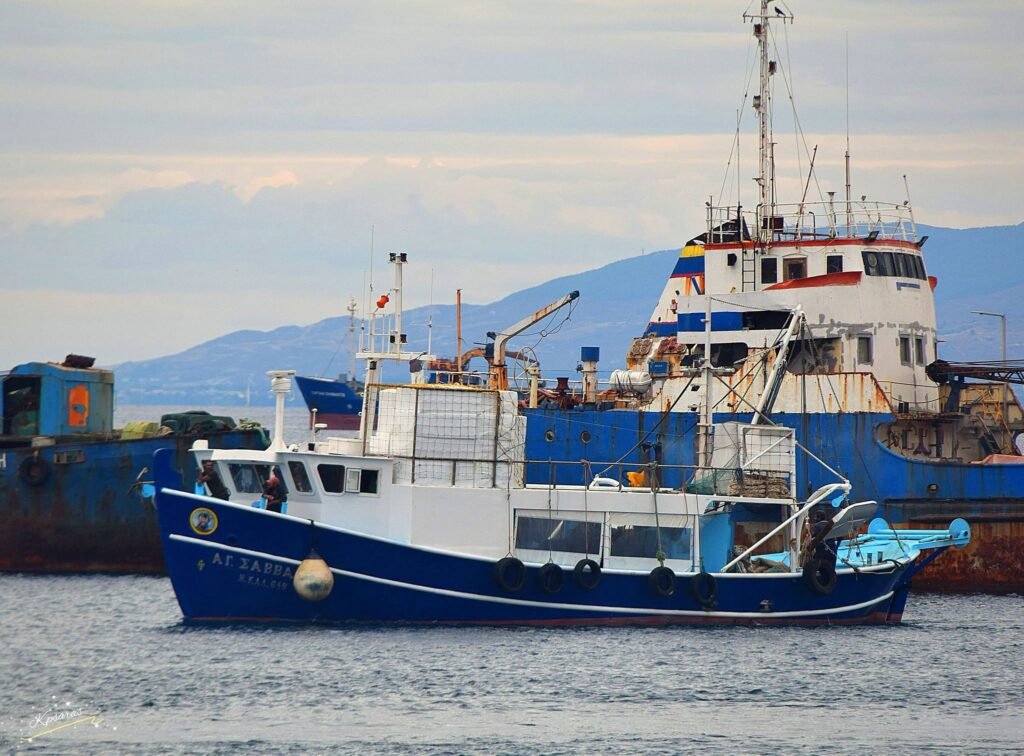
The indefinite work stoppage announced by the Greek Fishermen’s Initiative from October 1 has brought the industry’s struggle for survival into focus. In Kalymnos, reports of a possible escalation come alongside the decision of the island’s Coastal Fishermen’s Association to stay out of the protests.
With vessels remaining in port, fishermen taking part in the action are demanding government intervention over rising operating costs and damage which, they say, is making professional fishing financially unsustainable.
In a press release dated September 24, 2026, the Greek Fishermen’s Initiative announced an indefinite work stoppage beginning on October 1, warning that the industry had reached a critical point.
Its concerns include fuel and energy costs, damage to nets and fishing gear attributed to dolphins, and a phytoplankton bloom which, according to the statement, is disrupting fishing activity.
The organisers announced that vessels would remain in port until meaningful solutions were provided, along with plans to shut down fish auction markets. They also called on fish wholesalers, retailers and related businesses to support the action, and demanded the immediate activation of a fishing vessel withdrawal programme with fair compensation.
In Kalymnos, the prospect of boats heading towards Imia adds a potentially sensitive dimension to the protest. According to reporting by Evi Koukiani, island fishermen participating in the strike are considering taking their vessels to the area if their demands go unheard. Such a move could raise an issue with international repercussions. It is a reported possibility for escalating the protest, rather than an action that has already taken place.
Participation on the island, however, is not universal. According to reporting by Eirini Chalkiti, the Kalymnos Coastal Fishermen’s Association is not taking part. Its president, Manolis Koulias, objects to what he regards as the exploitation of the industry’s problems for party political purposes.
Ioannis Gavalas, a parliamentary candidate for Greek Solution in the Dodecanese, has appeared alongside the island’s medium-scale fisheries union. His presence is a separate element of the local protest; Koulias’s objection does not, in itself, establish that the mobilisation is directed by a political party.
The differing positions in Kalymnos show that, despite the unity presented in the Initiative’s statement, disagreements remain over how fishermen should pursue their demands and the political dimension of the protests.