
By Sakellarios G. Tsikouris*
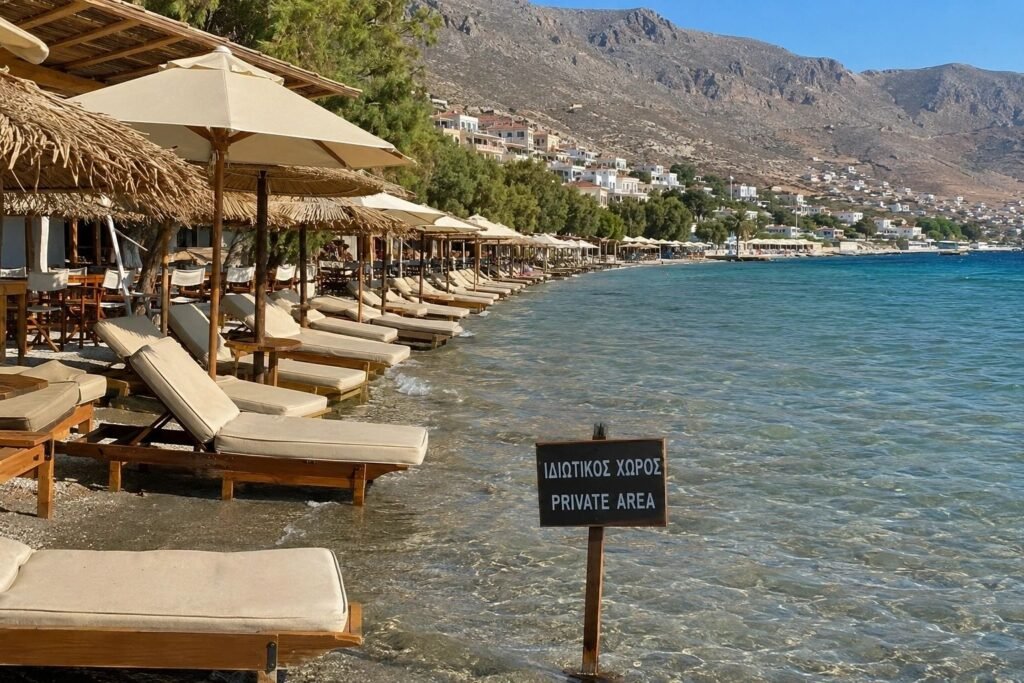
Kalymnos is widely known as the island of sponge divers and the sea. Yet, it seems that the local affection for the coastline has extended beyond people and into beach furniture. Across several beaches on the island, sunbeds, umbrellas, and outdoor seating have expanded almost to the water’s edge, occupying space that legally belongs to everyone.
Anyone reviewing the official permits for beach concessions might assume that most of Kalymnos’ beaches remain largely untouched. A walk along those same shores, however, reveals a very different reality. The gap between what is legally permitted and what is physically present often amounts to hundreds of square meters of unauthorized occupation of public space.
The issue is not merely aesthetic, nor is it limited to the summer tourist season. It concerns the very concept of public space. Beaches, squares, and sidewalks are shared assets and essential elements of social cohesion. They are the places where all citizens, regardless of income or status, enjoy equal rights of access and use.
When public spaces are gradually commercialized without effective oversight, a distorted reality emerges—one in which private profit outweighs the public interest. The simple act of laying a towel on a free section of beach is becoming increasingly difficult, while access to the shoreline is often conditioned by the presence of privately operated facilities occupying public land.
What the Law Says
Greek legislation clearly states that the seashore and beach zone are public assets whose primary purpose is to guarantee free and unobstructed access for all. The placement of umbrellas and sunbeds is allowed only within specific limits, while a free-access corridor along the coastline must always be maintained.
Similarly, sidewalks and public spaces within urban areas must remain accessible to pedestrians, people with disabilities, elderly residents, and families with strollers. Unauthorized structures or business expansions into public areas are prohibited and subject to penalties.
Time for Accountability
The real question is not why some businesses seek to expand beyond legal boundaries. The more important question is whether the responsible authorities are effectively enforcing the regulations already in place.
Free access to the sea and to public spaces is not a luxury. It is a fundamental right of both residents and visitors. Protecting that right requires more than legislation on paper. It demands enforcement, accountability, and active civic participation to ensure that Kalymnos preserves the open and authentic character that makes it unique.
*Sakellarios G. Tsikouris
Electrical Engineer
President, Technical Chamber of Greece (Kalymnos Branch)
Member, Executive Committee of TEE Dodecanese