
By Eleftheria Tiliakou, No Filter
The public consultation for the Local Spatial Plan (LSP) concluded on Wednesday, 11 February 2026. For the Municipality of Kalymnians, approximately 45 proposals were submitted by citizens, engineers, lawyers, and businesses — and only one by a municipal faction: the major opposition.
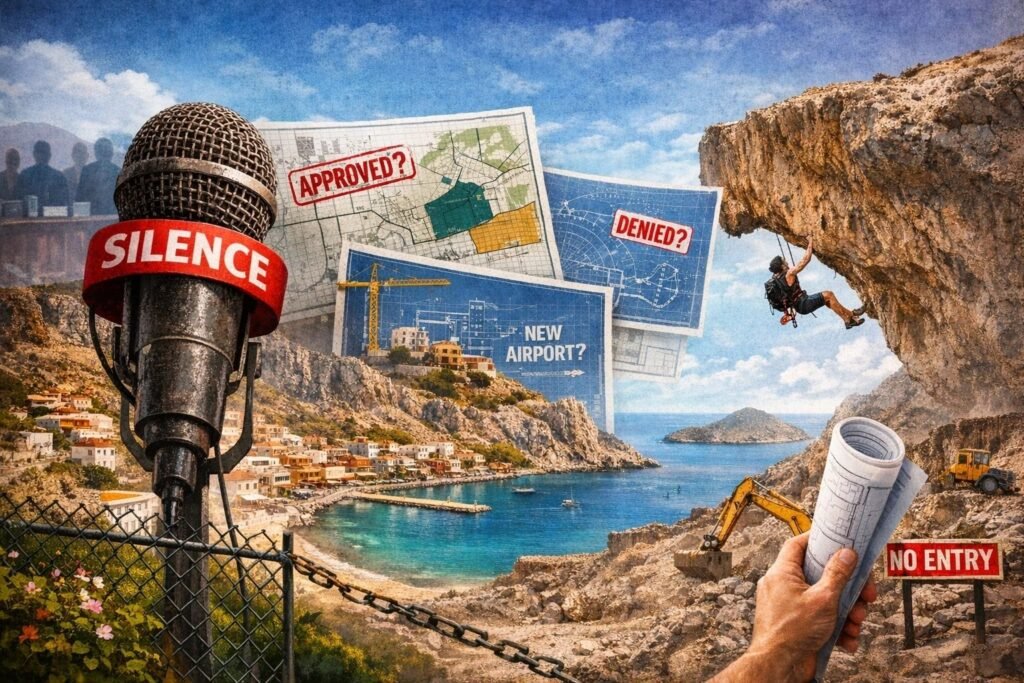
The dominant issue highlighted through the submissions concerned the shoreline zone, followed by settlement boundaries and the quarry issue.
Only the “Nea Kalymnos” faction submitted an official written proposal on the consultation platform. The remaining factions limited themselves to oral statements during the Municipal Council meeting of 9 February 2026 — the relevant videos are available for anyone wishing to review them.
This stance creates the impression that municipal spatial planning is not treated as a political choice, but rather as a purely technical matter for engineers. The factions, including the governing majority, appear to have taken cover behind the proposals of the Municipal Technical Service and the Technical Chamber of Greece (TEE), avoiding the responsibility of a clear political position.
They are well aware that the political cost will be significant and will be reflected in the next elections. The avoidance of an official stance by the majority of the political establishment reveals political timidity and a lack of vision for the island’s future.
The proposals of the “Nea Kalymnos” faction move along three main axes:
• protection of small properties and preservation of building eligibility standards
• balanced development of settlements and new infrastructure
• environmental protection and strengthening of alternative tourism
Particular emphasis is placed on:
— reaffirming and potentially expanding settlement boundaries,
— maintaining the out-of-plan building threshold at 4,000 sq.m.,
— protecting climbing fields as a key pillar of alternative tourism,
— creating a second port, a quarry zone, and a new airport,
— expanding the industrial and craft zone and opening new road corridors,
— establishing zones for mild tourism development and environmental protection.
These proposals aim at sustainable development without devaluing small property ownership.
Today, the island’s development remains uneven: the western side shows intense construction activity, while the eastern areas continue to decline. This pattern appears to be reinforced by planning proposals that do not encourage tourism growth beyond the already established zone.
The upcoming Municipal Council session on the LSP must take into account not only technical approaches, but also environmental protection, biodiversity, archaeological sites, primary production, climate change, and the opportunities of the digital economy.
Spatial planning is not neutral. It is a political act that shapes the future of Kalymnos.