

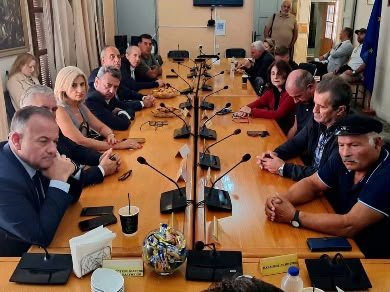
Following talks in Kalymnos, the Dodecanese MP calls for clarity on subsidy payments, effective maritime surveillance and action against illegal fishing.
Government announcements must translate into actual payments and practical solutions for fishermen, New Democracy’s Dodecanese MP Giannis Pappas has said, announcing a series of meetings with the relevant ministries over the coming week.
His statement follows talks in Kalymnos with Konstantinos Saroukos, president representing medium-scale fishing; Giannis Kardoulias, vice-president of the Association of Large Pelagic Fish Fishermen; and Manolis Koullias, president representing coastal fishing.
Pappas acknowledged that high fuel costs, rising prices and damage to equipment are squeezing professional fishermen’s incomes and threatening their livelihoods. He described their concerns as fully justified and recognised that unresolved issues require substantive answers.
“The announcement of a measure, its implementation and the actual payment of support are three different stages,” he stressed. Fishermen, he said, deserve to know who will receive assistance, when it will be paid and what the financial benefit will be.
According to his statement, seven measures were announced in June, including fishing fuel support of 16 euro cents per litre for April and May and 12 cents for June. A separate €16 million programme for investment in fishing vessels was also launched.
Pappas emphasised that these interventions serve different purposes and have different implementation timelines. They should therefore not be presented as evidence that the pressures currently facing the sector have been fully addressed. He also referred to his public intervention on 26 June concerning fishing fuel and pufferfish.
Addressing Turkish fishing vessels, Pappas cited Article 398 of the Greek Penal Code, which he said was introduced in 2021 and provides criminal penalties for unlicensed fishing by vessels from third countries in Greek territorial and internal waters. He nevertheless questioned whether the existing framework is sufficient and effectively enforced, calling for stronger surveillance, documented violations and full enforcement of the law.
He also argued that seasonal restrictions intended to protect fish stocks require scientific assessment, while illegal fishing demands decisive action.
The planned ministry meetings will focus on outstanding problems, he said, with the aim of turning fishermen’s needs into concrete decisions and measurable results.