
Maria Hatzichristodoulou
March 27, 2021
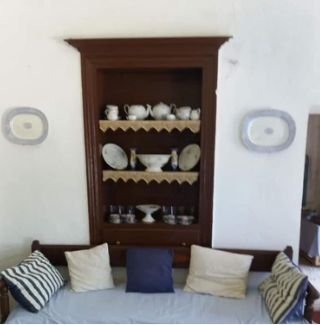
The carved wooden sofa celebrates its birthday today. It turns one hundred.
They even brought a cake with candles, placed proudly on the table set before it.
The cake is not exactly for him, of course. It is for the great-grandson who is turning five. Yet the joy is entirely his. They share the same birthday: he, an old great-great-grandfather, and the most beloved grandchild among all those he has known throughout a hundred years of family continuity.
He still becomes emotional when he remembers the first day they brought him into this house. Freshly polished from the carpenter’s workshop in Chora, he smelled wonderful. He was proud of his carved aristocratic back with its rosettes and spirals, his proudly curved arms, and the smooth surface of his base. Nearly two meters long and one meter high — he had been ordered for a noble island house, and that is how he felt.
They carried him carefully, as if he were a throne, and placed him with a commanding “hoooop” against the central wall of the living room, just as the captain’s wife had ordered.
She herself supervised the covering of the sofa with finely woven loom fabric and the decoration with cushions embroidered with red Moroccan thread, brought back from some voyage to the shores of the pirates.
The whole neighborhood paraded before him to admire him.
“May he bring joy,” “may he bring prosperity,” and “may you enjoy him with children and grandchildren,” the women blessed him like Fates scattering wishes.
He spread his Doric beauty proudly, carvings and all. He had been made to receive guests like a lord: relatives by marriage, brides and grooms, children climbing upon him; later, grieving visitors and relatives offered liqueur and wine “anama,” spoon sweets, and loukoumades.
Then came the war, after the Italians had arrived, and the noble house went through difficult years.
The three fishing boats were lost: two were accidentally sunk by the submarine Papanikolis, and the last one left one night on a smuggling trip and never returned. After the liberation, it was learned that it had escaped and anchored in Piraeus with its crew, who asked to cross into Greece.
Even so, during the Italian occupation he preserved his old splendor along with secrets and hidden meetings. The living room now opened only under the pretext of a visit, but in truth the guests whispered about uprisings and stone-throwing protests.
That was when he came of age without expecting it. He had not known that sofas, too, count time like people do.
But when they laid that fifteen-year-old boy upon him, his blood-soaked shirt dripping, while the mothers around untied their headscarves in mourning and lamented the young lad with ancient cries, he understood that his life was no longer his alone.
It was tied to the lives of people. Inseparable.
…
And as the little great-grandson blew out the candles on his cake, smearing him with chocolate, he declared proudly to his mother:
“I’m big now. Tonight I will sleep on grandpa’s old sofa.”