
By Eleftheria Tiliakou, No Filter
I never expected to write this article. Yet current events—the shocking and deeply disturbing nature of the subject—have made it necessary. If anything, I may already be late in writing it.
Several years ago, as a student in the Department of English Language and Literature at the National and Kapodistrian University of Athens, I chose an elective course entitled “Terrorism and Literariness.” I was genuinely curious to understand how literature approaches such a dark phenomenon. I expected an academic examination of propaganda, political violence, and the psychology of terror. What I did not expect was to study a book that, over hundreds of pages, explores terrorism through aesthetics, art, symbolism, and theatricality.
To be fair, the textbook explicitly condemns terrorism and defines attacks against civilians as criminal acts. That deserves recognition. It is neither an endorsement nor an apology for terrorism. Yet the essence of a university textbook is not contained in a single disclaimer; it lies in the totality of the ideas it develops. And that is precisely where the difficult questions begin.
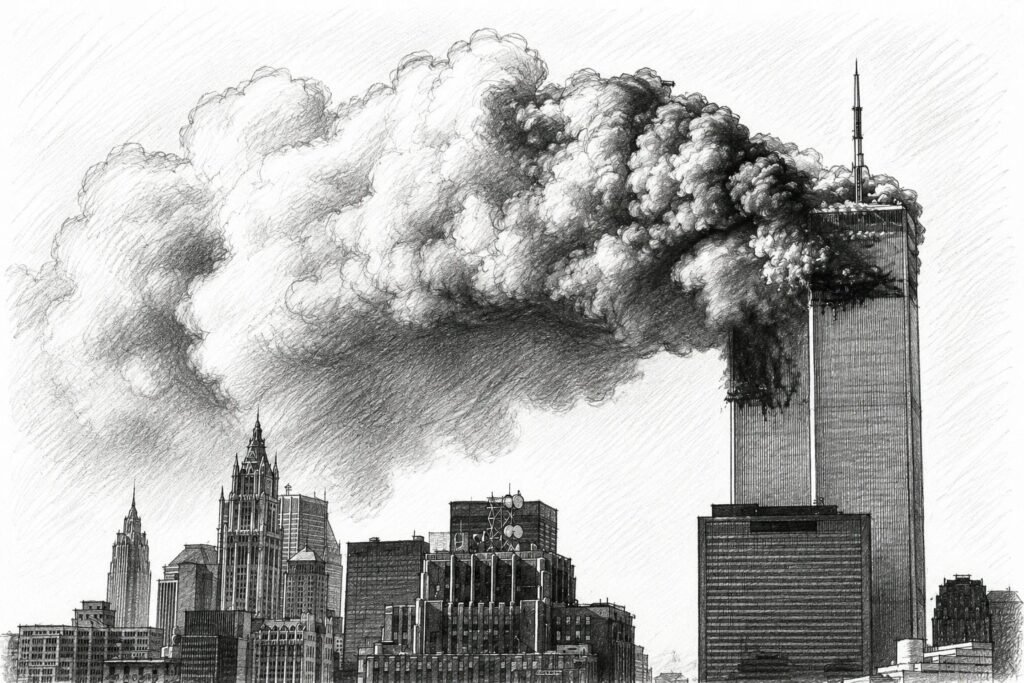
Throughout much of the book, terrorism is examined as an aesthetic phenomenon. The terrorist is presented as a creator of symbols. The terrorist act is discussed as a theatrical performance. Violence becomes a form of communication, while the aesthetics of terror occupy a central place in the analysis. These are, of course, well-established theories within international academic literature. The author did not invent them. The real question is not whether these theories exist. The real question is how they are taught.
At the time, I was already a mature student with professional and life experience. I was capable of distinguishing between the description of a theory and its moral evaluation. But could a first-year undergraduate or a twenty-year-old student always make the same distinction? I am not convinced. Universities should encourage difficult conversations. Censorship has no place in higher education. Academic freedom, however, carries academic responsibility. When hundreds of pages are devoted to analysing the aesthetic power of a terrorist act, its symbolic value, and its relationship with art and literature, there is a real risk that theoretical analysis may gradually become an aestheticisation of violence. That is not a trivial distinction.
Especially today, following the recent firebomb attacks on the homes of three New Democracy officials in Thessaloniki and the tragic death of one of the victims, Vagia Nestora, the issue becomes painfully relevant. One omission also struck me. Outside the scope of the academic analysis remain the victims of terrorism themselves. No attempt is made to examine them through the same aesthetic lens. What role do they play in the terrorist “performance”? Are they supporting characters in the creation of symbolic violence? Could we one day even have critics of “terrorist art”? These uncomfortable questions inevitably arise when terrorism is approached primarily through the language of aesthetics.
We live in an era in which young people are increasingly radicalised through videos, images and carefully constructed narratives. Terrorist organisations themselves invest heavily in aesthetics. They stage their videos. They create symbols. They build myths. Can a university course analyse these mechanisms without devoting equal effort to dismantling them? Knowledge itself is never dangerous. The way knowledge is presented can be. I am not arguing that this course should be abolished. Nor do I believe that difficult subjects should disappear from university curricula. What I do believe is that every university should ask itself a fundamental question:
Where does academic analysis end, and where does the aestheticisation of violence begin?
Because when a terrorist is presented—even theoretically—as an “artist,” some readers will see nothing more than an academic framework. Others, however, may perceive a dangerous myth. Universities exist to challenge myths, not to make them more seductive.
Readers who wish to examine the textbook themselves can access the English-language edition through the Kallipos academic publications platform: