
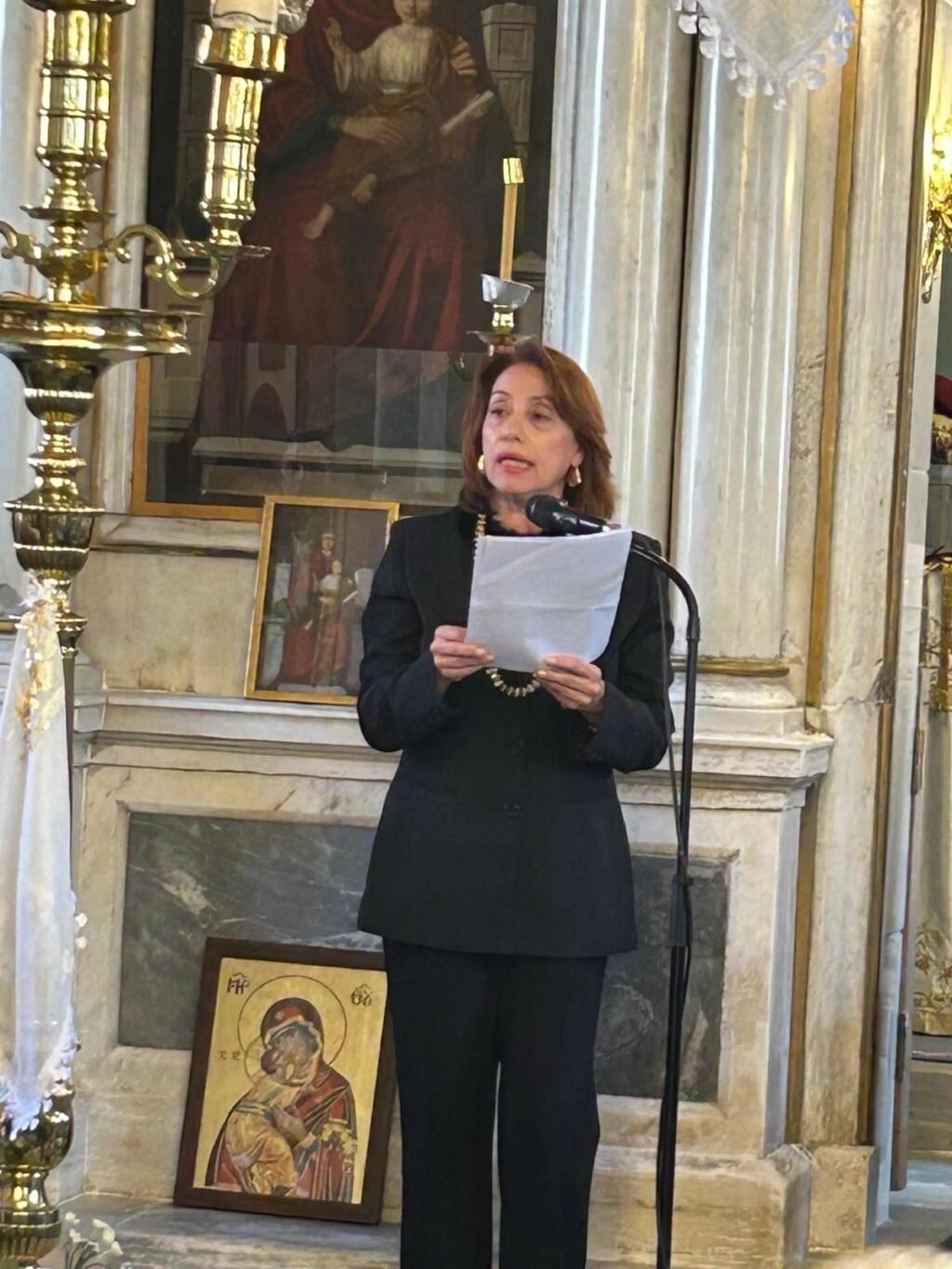
By Maria Chatzichristodoulou
Philologist, 2nd Lyceum of Kalymnos
Today we honor the National Resistance—the powerful, antifascist, national and popular movement that emerged when the Greek people rose in a struggle of life or death to drive the conqueror from their homeland. The National Resistance (1941–44), from a historical perspective, can only be compared with the immortal uprising of 1821 in terms of breadth, passion, and the sheer magnitude of the struggle, as thousands of fighters sacrificed even their lives for the freedom and independence of the country. It was one of the most massive and most combative resistance movements in Europe, and it significantly aided the Allies in their fight to crush German Nazism and liberate Europe.
But what exactly is the National Resistance as a historical event? Any act against the occupier is considered resistance. A defining act was the removal of the German flag from the Acropolis and the raising of the Greek flag by two university students, Manolis Glezos and Lakis Santas, barely a month after the surrender of Athens to the Germans. Another heroic act came from the Metropolitan of Zakynthos, who refused to hand over to the Germans—despite their demand—a list of the island’s Jewish residents. Resistance was the work of the “saltadoroi” of Thessaloniki, the barefoot orphaned children who stole from German trucks and helped partisans escape. Resistance was every family who hid a wounded fighter, sharing with him their scarce food.
The National Resistance we speak of today, the history with which we reckon, is something greater than individual patriotic acts. It is the continuation of the epic struggle on the Albanian front. According to historians, it constitutes the second phase of the same national liberation war, each phase with its own distinct characteristics.
When Greece was subdued by the fascist Axis and the King and official government fled to Cairo, the Greek people were left in a dire situation. Food and industrial goods were requisitioned, equipment was seized and transported to Germany, the currency collapsed, and the plunder of national wealth reached levels unmatched in any other European country. Food disappeared, the black market plundered the population, and deaths from hunger reached approximately 300,000 by the autumn of 1941. Arrests, imprisonments, the destruction of entire villages, hangings, executions, and hostage-taking formed the occupiers’ new order. This situation created an undeniable historical necessity: resistance.
This sacred duty was undertaken by the resistance organizations that emerged as early as September 1941.
On September 9, the National Republican Greek League (EDES) was founded by members of the old Venizelist faction under Napoleon Zervas. Active mainly in Epirus, it participated alongside ELAS in the sabotage of the Gorgopotamos bridge and at Popovo. Despite its significant action and its roughly twelve thousand members, it never acquired a broad popular base, largely by its own political choice.
In 1942, the National and Social Liberation (EKKA) organization was founded under Colonel Dimitrios Psarros, active in Epirus and Central Greece with a force of about 1,500 fighters.
Yet the decisive milestone came on 27 September 1941, when in a modest house in Hymettus the representatives of four small parties—the Communist Party of Greece, the Union of Popular Democracy, the Agrarian Party, and the Socialist Party—signed the founding document of the National Liberation Front, known as EAM. Under the harsh and complex conditions of triple occupation, EAM succeeded in mobilizing the overwhelming majority of the Greek people, creating what is justly called the epic of the National Resistance: a broad patriotic alliance uniting workers, peasants, the middle classes, youth, progressive intellectuals, a significant portion of the clergy, distinguished hierarchs and officers, and even part of the bourgeoisie.
EAM spread and grew in the cities and refugee neighborhoods, in the countryside and mountains. By 1944 it had 1.5 million registered members, with its legendary youth organization, EPON, numbering 600,000. Its armed force, ELAS, under the leadership of Athanasios Klaras (Aris Velouchiotis), by the eve of liberation amounted to a full army corps across the country—with divisions and regiments from Macedonia to Crete, and even naval units (ELAN). Its total force reached 51,000 fighters, while the reserve ELAS added another 30–50,000.
Across Greece, the people organized, resisted, and fought the occupier, paying a heavy blood price. Resistance forces protected crops in the Thessalian plain, fought against hunger and executions, prevented forced labor conscription with mass strikes, confronted both Axis troops and their Greek collaborators, halted Bulgarian expansion plans, held free elections in the mountains, and formed the “mountain government” PEAΕA in Koryschades. They opened schools, staged theatre performances, and even founded a Pedagogical Academy. Their action did not go unnoticed by the Allied headquarters, which recognized them as an integral part of the Allied military effort.
On 25 November 1942, combined forces of ELAS, EDES, and British saboteurs blew up the Gorgopotamos bridge, disrupting the movement and supply of German troops. This first major success of Greek partisans was proof that the resistance groups aimed at unified national action. But the British had other plans. Their policies gradually led to the division of the resistance—a strategy with tragic consequences for Greece.
A testimony from the 1981 scientific conference marking 40 years since the founding of EAM was revealing. Dimitris Papamichail, representing EDES, stated that British commander Eddie Myers had proposed unifying all resistance groups, a plan accepted by all. Elections for self-governing bodies were held in 1943, but before these decisions were implemented, the British overturned them, recalling Myers and appointing Woodhouse in his place.
When on 12 October 1944 the forces of ELAS liberated Athens and handed it over to the British, the city lived one of the most emotional moments in its history. No one, however, suspected what would follow a month later: the December clashes—Dekemvriana—the beginning of the civil war, meticulously orchestrated by the British.
This is another chapter of our history. What matters here is that the civil war and the defeat of the Democratic Army, as ELAS was later renamed, led to the suppression and marginalization of the National Resistance. Its members were persecuted and silenced, and references to their struggle were banned from schoolbooks. Those who had liberated the country found themselves exiled, hunted, and excluded.
Yet the National Resistance was never forgotten by the people. It became song, slogan in bloodied demonstrations, a student’s cry, sacrifice, the anti-dictatorial struggle—Polytechneio. It remained alive in every fight for democracy and independence. Thus, on 18 August 1982, when the Greek Parliament finally recognized the unified National Resistance, the path opened for us to honor it freely today and to give it its rightful place—as a badge of honor for the country.
Let me close, not with another historical detail, but with a few verses from Yannis Ritsos’ Romiosini:
“A messenger arrives from Megali Lagkadia every morning
the sweat-lit sun shining on his face
under his arm he holds Romiosini tightly
as a worker holds his cap inside the church.
The time has come, he says.
We must be ready.
Every hour is our hour.”