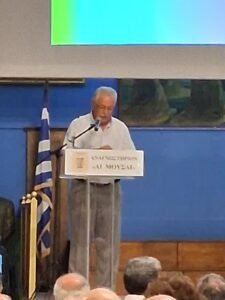

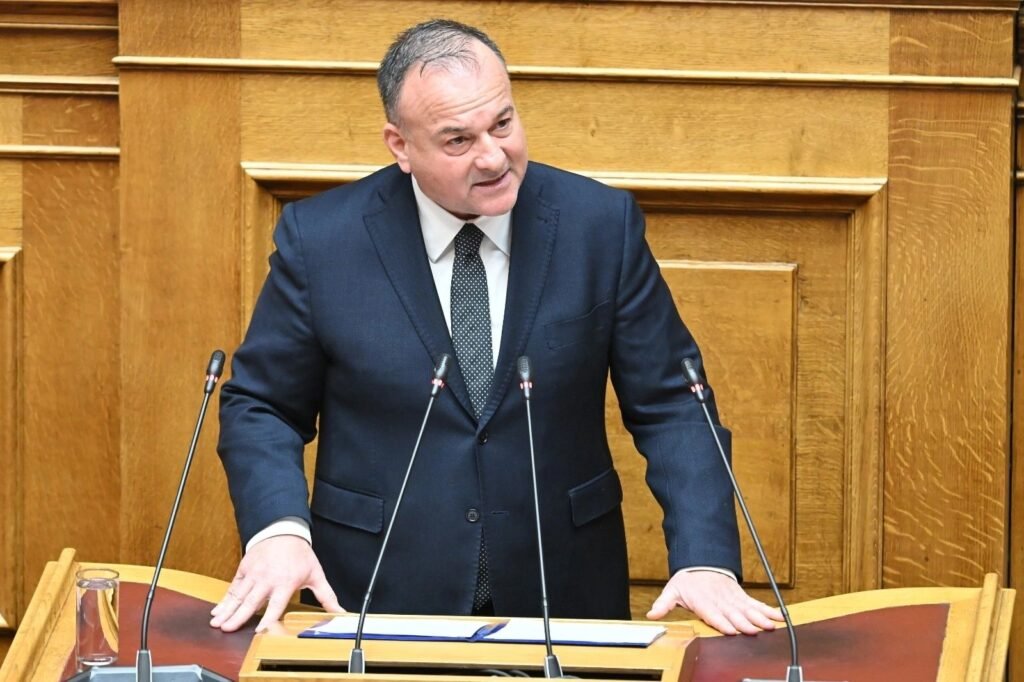
The Dodecanese MP addressed Parliament during the debate on hydrocarbon exploration agreements, including cooperation with Chevron.
Dodecanese MP of New Democracy, Ioannis (Giannis) Pappas, spoke in the Hellenic Parliament during the debate on the Ministry of Environment and Energy’s bill ratifying agreements for hydrocarbon exploration and exploitation, including cooperation with the energy company Chevron.
Pappas emphasized that the ratification of the four agreements represents a mature institutional decision of national importance, linking Greece’s energy strategy with national security, economic prospects with geopolitical stability, and development policy with long-term responsibility toward the country.
He noted that the legislative initiative of the Ministry of Environment and Energy follows a fully institutional procedure, as the agreements were submitted for ratification after completing all required processes and receiving approval from the Court of Auditors.
Referring to the significance of the initiative, Pappas stated that with the addition of four new exploration blocks, Greece effectively doubles the maritime areas currently under exploration, increasing the chances of discovering economically viable reserves and creating new prospects for the country’s energy self-sufficiency.
He made special reference to Chevron’s participation, stressing that the involvement of one of the world’s largest energy companies constitutes a strong vote of confidence in Greece’s institutional reliability, stability, and geostrategic value as an energy destination.
The Dodecanese lawmaker also highlighted the geopolitical dimension of the agreements, noting that the company’s activity in the areas “South of Crete 1” and “South of Crete 2” reinforces Greece’s position by effectively recognizing Greek jurisdiction in those maritime zones.
According to him, this development weakens the illegal and unfounded Turkey-Libya memorandum.
He also underlined that developing energy resources requires long-term planning and continuity of state policy, recalling that Greece’s national strategy on hydrocarbons began years ago and continues consistently through successive international tender rounds.
Pappas further stated that the government’s current policy is part of a broader strategy to strengthen Greece’s geostrategic position.
In recent years, Greece has systematically enhanced its deterrence and international presence, through the upgrade of F-16 Viper fighter jets, the reinforcement of the Hellenic Navy with new frigates “Kimon” and “Psara”, and the deployment of Patriot air defense systems in critical areas of the country.
Concluding his speech, he stated:
“Today we are not simply voting on agreements. We are voting for a choice with institutional depth, developmental logic, and national significance — a choice that strengthens our energy security, enhances the country’s geostrategic position, and creates conditions for growth and prosperity for future generations.”
He added that Greece needs a stable strategy, institutional continuity, and determination — principles that are reflected in the ratification of the agreements.